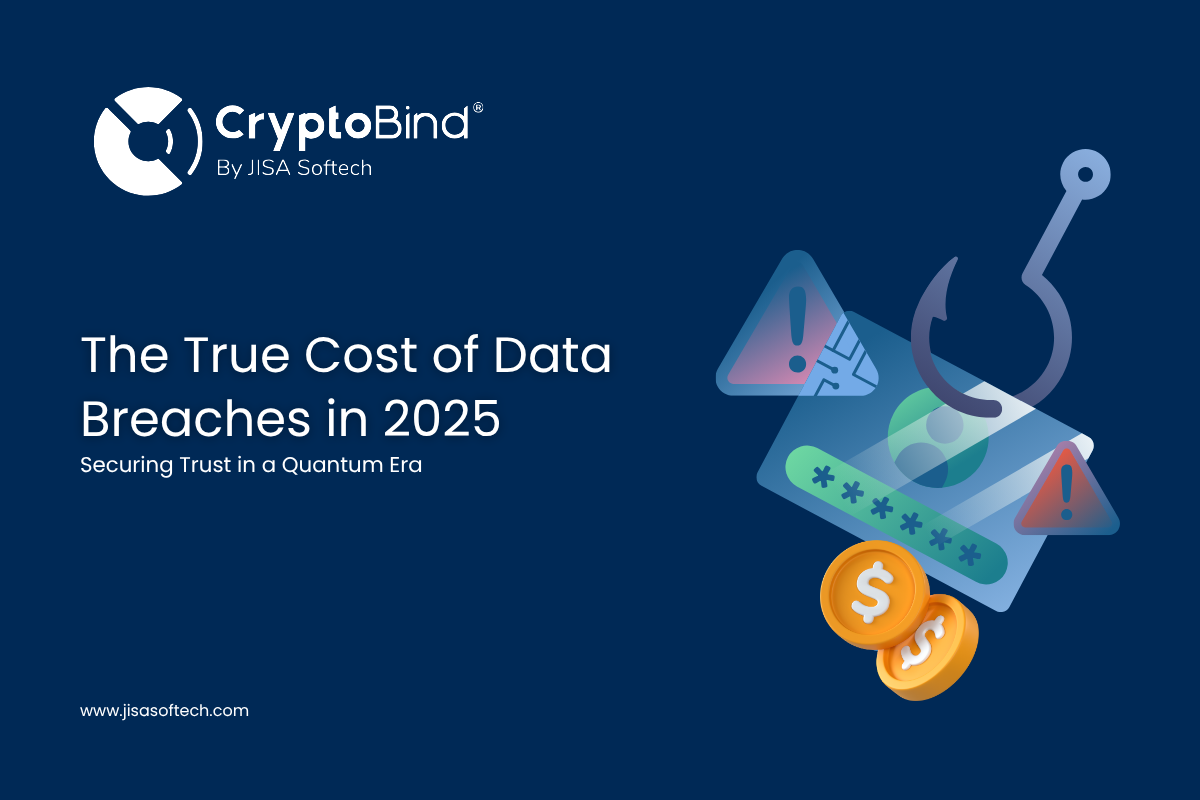
The True Cost of Data Breaches in 2025
In 2025, the conversation around data breaches has shifted from “if” to “how often and how bad.” Boards and regulators now require provable controls as opposed to policies. And even though there are better headline numbers this year, the monetary, legal and strategic cost of breaches is still high and gets disproportionately distributed between geographies and sectors.
What the numbers really say
The current international standards estimate the average price of data breach to be 4.44 million in 2025, although this is a minor decrease as compared to 2024 as organizations become better at detecting and containing breaches with the help of AI and automation. Though positive, it is hardly a win instead of years of upward growth.
However, averages conceal extremes. The costs of detection, escalation, and legal costs in the United States were high with an average cost of breach costing more than 10 million. In India, the mean was close to ₹ 22 crore, as a result of the regulatory scrutiny and expansion of clouds among big businesses.
Speed still matters: the average time to identify and contain a breach is 241 days, a nine-year low but still two-thirds of a year of exposure. Each day of delay compounds risk, cost, and reputational fallout.
The invisible balance sheet: beyond immediate loss
Financial impact. The incident response, forensics and crisis communications are the tip of the iceberg. Business disruption and customer loss are the greater costs that can constitute more than half of the total costs. The actual cost may be many times more in regulated industries like the banking sector, insurance industry, and the health sector, with downstream litigation, regulatory fines, and compulsory audit.
Legal and regulatory exposure. Enforcement intensity is rising. The GDPR enforcement regime has amassed cumulative fines nearing €6 billion by early 2025, and this year’s orders included individual fines in the hundreds of millions, including a €530 million sanction tied to data transfer and transparency failures. Regulators are testing not just breach response, but design-time decisions around cross-border data movement, vendor oversight, and lawful bases for processing.
Strategic drag. Beyond the financial and legal consequences, breaches inflict operational paralysis, delayed launches, frozen partnerships, and leadership distractions that slow innovation. They also force expensive cryptographic overhauls, diverting resources from digital transformation initiatives. In essence, a data breach is no longer a technical crisis, it’s a strategic setback.
Why HSMs are essential, not optional
The most essential question in the context of breach prevention is: who holds the keys? The security of encryption only depends on the security of the cryptography keys. In case such keys are stolen, encryption will be pointless.
Hardware Security Modules (HSMs) safeguard this foundation by generating, storing, and using cryptographic keys within tamper-resistant hardware, isolated from general-purpose computing environments. This guarantees that keys are secure and auditable brought about by the fact that even systems that are compromised are still secure.
Three reasons why HSMs have become essential for enterprises in 2025:
- Containment by design. Breach costs correlate directly with the extent of compromise. HSMs restrict key exposure, ensuring that even if an application layer is breached, encryption keys cannot be extracted.
- Compliance proof. Regulations and standards increasingly mandate hardware-backed cryptographic controls. Auditors now focus not merely on whether data is encrypted, but where keys reside and under what policies they operate.
- AI and data sprawl. With the explosion of AI workloads, APIs, and digital identities, secret material is everywhere: API keys, signing keys, tokenization maps. HSMs anchor trust by providing centralized, policy-enforced management for all cryptographic assets across hybrid environments.
Design principles for 2025-ready key protection
1. Segregate by default. Separate trust zones for applications, tenants, and environments. Treat each HSM partition as a boundary of trust to limit the breach blast radius.
2. Automate lifecycle management. Keys must have defined owners, automated rotation schedules, and revocation processes. Delayed rotations increase audit complexity and forensic cost.
3. Build for crypto agility. As post-quantum algorithms mature, organizations must ensure their cryptographic architecture can switch algorithms and key lengths without rewriting code. Crypto-agile design futureproofs systems against emerging threats.
4. Integrate with attestation. Connect HSMs to code-signing and runtime attestation processes, ensuring that every piece of software is verifiably untampered.
5. Prepare for legal defensibility. Incident response is not just technical, it’s legal. HSM-backed telemetry provides regulators with verifiable audit trails that prove policy enforcement and compliance.
Where CryptoBind fits
Enterprises now ask: “Can we secure our keys without slowing innovation?” and “Will today’s crypto withstand tomorrow’s threats?” This is where CryptoBind redefines the equation.
CryptoBind delivers Cloud and On-Prem HSM solutions that combine certified hardware security with the flexibility of modern, API-driven architectures. Its design philosophy aligns directly with enterprise mandates for crypto agility and quantum readiness.
- Quantum Ready: CryptoBind’s infrastructure supports seamless migration to post-quantum algorithms, allowing enterprises to adopt next-generation encryption standards as they evolve; without architectural overhaul.
- Crypto Agile: The platform decouples applications from specific algorithms, enabling policy-based cryptographic decisions. Whether RSA, ECC, or post-quantum suites, CryptoBind enforces adaptable protection without disrupting workflows.
Operationally, CryptoBind offers dedicated virtual HSM instances, each with isolated access, defined policies, and audit-grade logging. Its high-availability configurations ensure continuous key access, while automated lifecycle management streamlines rotations and policy updates.
Beyond technology, CryptoBind embodies a strategic vision: to make cryptographic governance simpler, measurable, and scalable for enterprises confronting modern data challenges.
The board takeaway
2025 has not ended the era of breaches, but it has clarified their economics. While detection times and automation have improved, regulatory expectations have sharpened and AI-driven data sprawl has expanded attack surfaces.
In this environment, HSMs are no longer an optional investment, they are the backbone of digital trust. They limit exposure, provide verifiable control, and anchor compliance. The new boardroom question isn’t “Do we encrypt?” it’s “Can we prove control over our cryptographic keys?”
For organizations building resilience, the roadmap is clear:
- Anchor trust in hardware.
- Build crypto-agile frameworks that evolve with cryptographic standards.
- Ensure every component is quantum ready for the future of encryption.
CryptoBind is at this crossroads of trust and change assisting companies to secure data, verify identities and future-proof their businesses to the post quantum age. CryptoBind makes sure that even the cost of any breach goes much beyond the money: in a world where the price of a breach is much higher.