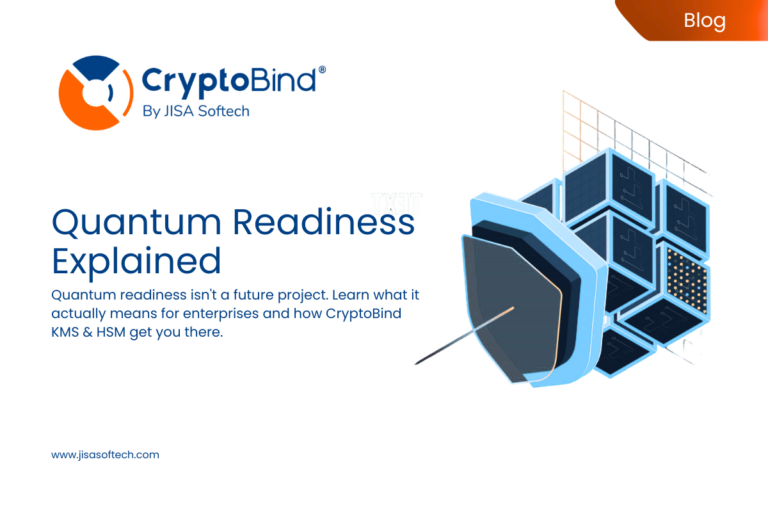
Quantum-Ready HSM: Is Your Business Prepared?
The race toward quantum computing supremacy is no longer confined to research labs, it’s entering boardrooms, policy discussions, and digital strategy sessions across the globe. What was previously a hypothetical risk to encryption has become a kind of question of business survival: When quantum computers are powerful enough to crack modern cryptography, will your organization still be safe?
This is not a discussion on what might happen in the future, but on the current preparedness. The rise of quantum computing represents not just a technological breakthrough but a turning point in how trust, identity, and data security will be defined for decades to come.
From Digital Security to Quantum Uncertainty
Modern cybersecurity is based on the cryptographic algorithms RSA, ECC, and others that are based on the mathematical intractability of some problems. That equation is now completely different with quantum computing and its capability to carry out the large-scale calculations using qubits. Other algorithms like the Shor algorithm can factor large numbers exponentially quicker and it essentially breaks down the foundations of public-key cryptography.
This ability makes the best known encryption methods of to-day insecure, not because quantum systems are currently popular, but because they will be and the data that is being presently encrypted may still be valuable when they are. Nation-states and advanced threat actors already engage in “harvest now, decrypt later” strategies: intercepting encrypted data today to unlock it once quantum capabilities mature.
The quantum challenge is therefore not theoretical; it is cumulative. With each day that goes by without preparation, the risk exposure of sensitive information increases, which could be decrypted immediately in the future.
The Strategic Imperative: Preparing Before It’s Too Late
Quantum readiness is never about the coming of new technology, it is about whether your organization can change the way it thinks of security. It is a change in attitude towards protection to resilience, towards unadaptive compliance to adaptive cryptography.
Forward-looking organizations are now taking a phased approach to post-quantum transformation:
- Cryptographic Discovery and Inventory:
Understanding where and how cryptography is applied is the first step. Many enterprises lack visibility into which systems use outdated algorithms or unmanaged keys. - Risk Prioritization:
Not all assets face equal exposure. Identify high-value, long-lifecycle data like intellectual property, financial records, or citizen information, that must remain confidential for years. - Crypto Agility Frameworks:
The ability to pivot cryptographic mechanisms without disrupting operations is critical. Building crypto agile architectures ensures flexibility as post-quantum standards evolve. - PQC Algorithm Testing and Integration:
Organizations should begin piloting post-quantum cryptography (PQC) algorithms today, alongside classical ones to ensure seamless migration when standards mature. - Ecosystem Alignment:
Supply chains, APIs, and partners must also be part of the quantum readiness journey. The security of one link affects the integrity of all.
This proactive roadmap turns an existential threat into a structured transformation journey, where preparedness becomes a competitive differentiator.
Redefining the Role of Hardware Security Modules
At the core of this transformation lies the Hardware Security Module (HSM) , the silent guardian of digital trust. HSMs are purpose-built to generate, protect, and manage cryptographic keys. Yet, most legacy HSMs were designed for a static world of predictable algorithms.
The quantum era demands a new generation of quantum-ready HSMs that embody flexibility, scalability, and algorithmic independence. These devices should be able to process both traditional and PQC algorithms simultaneously as this would allow the enterprises to migrate over a gradual process instead of radical jump.
Also, with the further proliferation of digital ecosystems with a hybrid and multi-cloud setup, HSMs will have to be service oriented and reachable through APIs, programmable through policy, and consistent with DevSecOps pipelines. The HSM of the future is no longer a hardware device, it is a crypto agility engine which facilitates transformation, not limits it.
The CryptoBind Vision: Enabling Quantum-Ready Confidence
In this landscape of rapid change, CryptoBind emerges as a transformative force, bridging the gap between legacy security and post-quantum resilience.
CryptoBind’s suite of Hardware Security Modules (HSMs) and Key Management Systems (KMS) is purpose-built for organizations pursuing quantum-ready and crypto-agile operations. Through its Cloud HSM offering, CryptoBind provides dedicated, virtualized, FIPS 140-3 Level 3 certified HSM instances with customer-specific policies and elastic scalability.
This architecture not only secures current cryptographic workflows but also ensures future compatibility with PQC algorithms. CryptoBind’s approach integrates:
- Algorithmic Flexibility: Support for classical and emerging PQC standards.
- Dedicated Security Instances: Virtualized, isolated HSM environments for compliance and control.
- API-Based Integration: Seamless connectivity to enterprise and cloud-native applications.
- Policy-Based Governance: Dynamic key lifecycle and access controls that adapt to new cryptographic requirements.
In a world moving toward quantum disruption, CryptoBind positions organizations to transition with confidence, ensuring that cryptographic infrastructure evolves as quickly as the threats themselves.
Why Acting Early Defines Leadership
Becoming quantum-ready is not about reacting to a distant technological milestone; it’s about leading through uncertainty today. The organizations that begin adapting now will set the benchmarks for digital trust, compliance, and operational continuity in the post-quantum world.
There are three compelling reasons why early action matters:
- Long-term Data Protection: Today, information that is encrypted can be useful in 10 or 20 years. Migration to quantum safety should begin prior to the implementation of quantum attacks.
- Regulatory Readiness: Global standards from NIST PQC selections to EU DORA compliance are already shaping policy timelines.
- Operational Advantage: If the earliest users of crypto agile patterns will have fewer transition costs, will not be locked-in to any specific vendor, and will innovate more rapidly safely.
The post-quantum transition is not just the matter of achieving cryptography, it is the matter of achieving relevance. Enterprises that fail to prepare early enough stand to be left behind in an age and era where trust has been mathematically redefined.
From Threat to Transformation
The quantum era is inevitable. The only question is how ready we will be when it comes. The question to the enterprises is no longer whether quantum disruption will occur or not but the speed at which they can adjust to it.
Building a quantum-ready infrastructure is not a defensive act, it’s a declaration of foresight. It represents a company that highly appreciates the integrity of its digital future the same way it appreciates its operation present.
In this redefined landscape, crypto agility becomes the language of resilience, and quantum readiness the new benchmark of trust.
CryptoBind is a strategic collaborator in the process and helps businesses to travel through the path of vulnerability into a vision, risk to readiness.
Start Your Quantum-Ready Journey Today
See how CryptoBind enables crypto-agility and post-quantum resilience across your enterprise.
Request a Demo