How CryptoBind’s Encryption Suite Addresses DPDP Act Requirements
India’s Digital Personal Data Protection (DPDP) Act, 2023 is no longer a distant legislative horizon.As enforcement provisions are actively being operationalized, and Data Protection Board is taking shape, Chief Information Security Officer in BFSI and Healthcare sectors are now facing an unwelcoming mandate: demonstrate that personal data is being safeguarded by demonstrably, audibly and proportionally technical controls.
For CISOs who have navigated GDPR, RBI’s Master Directions on IT Governance, or HIPAA-equivalents, the DPDP Act will feel familiar in intent but distinctly Indian in scope and nuance. The Act establishes clear obligations around purpose limitation, data minimization, storage limitation, and security safeguards, all of which have direct technical implications on how organizations store, process, and access personal data.
The question for security leaders is not whether to comply, but how to architect compliance in a way that is operationally sustainable, audit-ready, and technically defensible. Here CryptoBind integrated encryption suite, including Hardware Security Modules (HSM), Transparent Data Encryption (TDE), and a centralized Key Management System (KMS) provides a consistent, provision-by-provision solution.
Table of content
Understanding the DPDP Act’s Technical Obligations
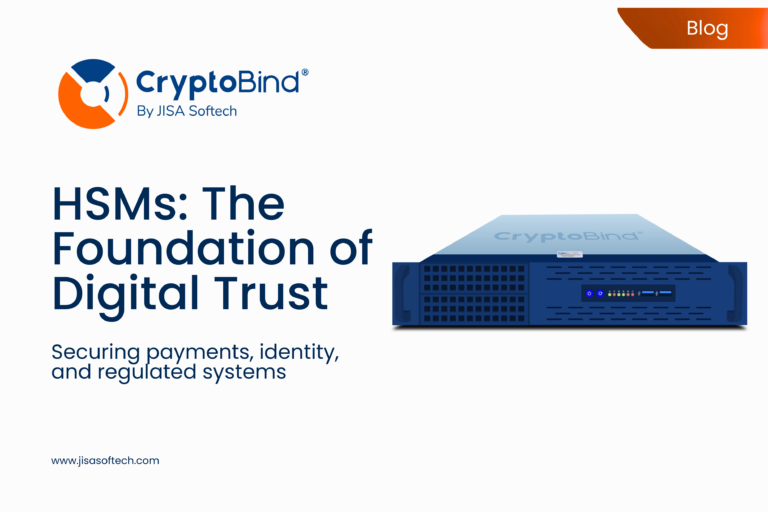
CryptoBind HSM: Establishing the Root of Trust
CryptoBind TDE: Protecting Data Where It Lives
CryptoBind KMS: Governing the Key Lifecycle
A Unified Compliance Architecture
Strategic Considerations for CISOs
Understanding the DPDP Act’s Technical Obligations
It is necessary to remove the clauses which bear an express or implied technical burden before attempting to map capabilities to provisions:
- Section 8(4) – Security Safeguards: Data Fiduciaries should take appropriate technical and organizational measures to ensure the safety of personal data. The universally accepted minimum technical protection is encryption.
- Section 8(7) – Data Retention and Erasure: Data Retention and Erasure: Personal data should be erased after the purpose of processing is met, and there has to be verifiable mechanisms in place.
- Section 9 – Processing of Children’s Data: Heightened protections requiring stricter access controls and verifiable consent architectures.
- Section 17 – Significant Data Fiduciary Obligations: Higher-risk organizations (large-scale BFSI and Healthcare organizations are likely to fall into this category) will be required to conduct periodic Data Protection Impact Assessments (DPIAs) and audit data processing activities.
- Draft Rules – Breach Notification: Requirement to disclose a breach of personal data within defined deadlines, which suggests capabilities to detect and maintain a forensic audit trail.
Combined, these provisions require that personal data should be encrypted at rest and in transit, access to decryption should be strictly controlled and monitored, and it should be precisely governed in the entire lifecycle of cryptographic keys. The architecture of CryptoBind is specifically created to do so.
CryptoBind HSM: Establishing the Root of Trust
At the foundation of any defensible encryption strategy lies the question: where is the cryptographic key ultimately protected? Software-based key storage, keys residing in application memory or config files, is a recognized vulnerability that regulators and auditors increasingly reject as insufficient.
CryptoBind’s Hardware Security Module establishes a tamper-resistant, FIPS 140-3 Level 3 certified root of trust. In practical terms, this means:
Alignment with Section 8(4): The HSM generates, stores, and processes cryptographic keys within a physically and logically protected boundary. Even if application servers or cloud environments are compromised, the HSM ensures master keys remain inaccessible to attackers. For BFSI institutions managing customer financial data and Healthcare organizations protecting patient health records, this is the architectural foundation that makes Section 8(4)’s “appropriate technical measures” demonstrably credible to auditors.
Audit Trail and Forensics for Breach Notification: All cryptographic operations carried out with the help of CryptoBind HSM are recorded with the time stamp, identity, and the type of operation. Such an undisruptible audit trail can be used in the case of personal data breach, to quickly reconstruct the forensic information needed to promptly notify the breach under draft DPDP Rules, establishing what data was accessed, by whom and when.
Regulatory Examination Readiness: For Significant Data Fiduciaries undergoing DPIAs under Section 17, HSM-backed key management provides quantifiable evidence of cryptographic security posture, a critical input to any impact assessment.
CryptoBind TDE: Protecting Data Where It Lives
The most commonly used attack vectors in both BFSI and Healthcare include unauthorized access to databases, whether by insider threat agents, improperly configured access controls, or physical theft of media. Transparent Data Encryption is the only system which is practically useful in organizations that operate core banking systems (legacy), claims databases, or electronic health record (EHR) systems.
Alignment with Section 8(4) and Storage Security: CryptoBind TDE encrypts data files, log files, and backups at rest using AES-256 encryption. Critically, “transparent” here means that authorized applications and users experience no change in behavior, the encryption and decryption occur seamlessly at the database engine layer. For BFSI institutions where system downtime is commercially catastrophic, TDE delivers compliance without operational disruption.
Alignment with Section 8(7) – Verified Data Erasure: One of the DPDP Act’s most operationally challenging requirements is demonstrable data erasure. CryptoBind TDE supports cryptographic erasure, the practice of destroying the encryption key associated with a data set, rendering the encrypted data permanently irrecoverable without deletion of individual records. This is particularly valuable for Healthcare organizations managing retrospective patient data purges, and BFSI firms handling retention obligations post-account closure.
Segregation of Sensitive Data Classes: CryptoBind TDE enables column-level and tablespace-level encryption policies, allowing organizations to apply heightened encryption to fields containing Aadhaar numbers, financial account identifiers, or medical diagnoses, aligning with the Act’s implicit principle of proportionate protection based on data sensitivity.
CryptoBind KMS: Governing the Key Lifecycle
Encryption is only as strong as the discipline applied to key management. An organization may deploy best-in-class encryption algorithms and still be vulnerable if keys are shared informally, never rotated, or stored alongside the data they protect. CryptoBind’s centralized Key Management System closes this gap.
Policy-Driven Key Lifecycle for Compliance Governance: CryptoBind KMS enforces automated key rotation schedules, expiry policies, and access control matrices, ensuring that no individual can access a decryption key outside of defined authorization workflows. For Significant Data Fiduciaries required to demonstrate governance maturity under Section 17, the KMS provides a single pane of visibility across all encryption keys, their ownership, status, and access history.
Role-Based Access Control Aligned with Purpose Limitation: Section 4 of the DPDP Act establishes the principle of purpose limitation, personal data may only be processed for the specific purpose for which consent was obtained. CryptoBind KMS enforces this at the cryptographic layer by binding key access permissions to defined roles and contexts. A credit operations team can decrypt loan account data; they cannot decrypt health insurance records in the same environment, because the KMS enforces this boundary technically, not merely by policy.
Multi-Cloud and Hybrid Environment Support: BFSI and Healthcare organizations increasingly operate hybrid environments, on-premise core systems alongside cloud-hosted analytics or CRM platforms. CryptoBind KMS provides centralized key governance across these boundaries, ensuring that the DPDP Act’s obligations apply uniformly regardless of where personal data resides or is processed.
A Unified Compliance Architecture
What distinguishes CryptoBind’s approach is not the strength of any individual component but the coherence of the suite as an integrated compliance architecture. HSM, TDE, and KMS are designed to operate in concert:
- HSM ensures the security of the master keys that control the activities of TDE and KMS.
- KMS coordinates major distribution, rotation and access policy enforcement of all workloads.
- TDE makes sure that data at rest is always encrypted with keys managed by KMS and based on HSM.
For BFSI CISOs presenting to Risk Committees or Healthcare CISOs responding to DPDP audit queries, this layered architecture translates into a clear, defensible narrative: personal data is encrypted with industry-standard algorithms, keys are managed through governed, auditable workflows, and the root of trust is hardware-anchored and tamper-resistant.
Strategic Considerations for CISOs
As you evaluate DPDP readiness, three questions are worth anchoring your strategy:
1. Can you demonstrate, not just assert, that personal data is protected? Regulators will require evidence, not assurances. CryptoBind’s audit logs, key usage reports, and encryption coverage dashboards provide that evidence.
2. Is your encryption architecture operationally sustainable? Compliance that breaks business processes will not survive. CryptoBind’s TDE and KMS are designed for enterprise operational environments where availability and performance are non-negotiable.
3. Does your key management governance reflect the sensitivity of the data it protects? The DPDP Act’s proportionality principle implies that a savings account record and a psychiatric diagnosis warrant different protection architectures. CryptoBind’s policy engine enables this differentiation.
Conclusion: Compliance as a Security Posture, Not a Checkbox
The DPDP Act represents India’s maturation as a data governance jurisdiction. For BFSI and Healthcare organizations entrusted with the most sensitive personal data their customers and patients possess, compliance is not a legal formality, it is an expression of institutional integrity.
CryptoBind’s encryption suite HSM, TDE, and KMS provides the technical foundation to meet the Act’s requirements with precision, auditability, and operational resilience. For CISOs building their DPDP compliance architecture, the path forward begins with a root of trust and extends through every layer of data at rest, in transit, and in use.
The question is not whether your encryption is adequate. The question is whether you can prove it.
CryptoBind offers architecture reviews and DPDP readiness assessments for BFSI and Healthcare organizations. Connect with our team to map your current encryption posture to DPDP Act provisions.