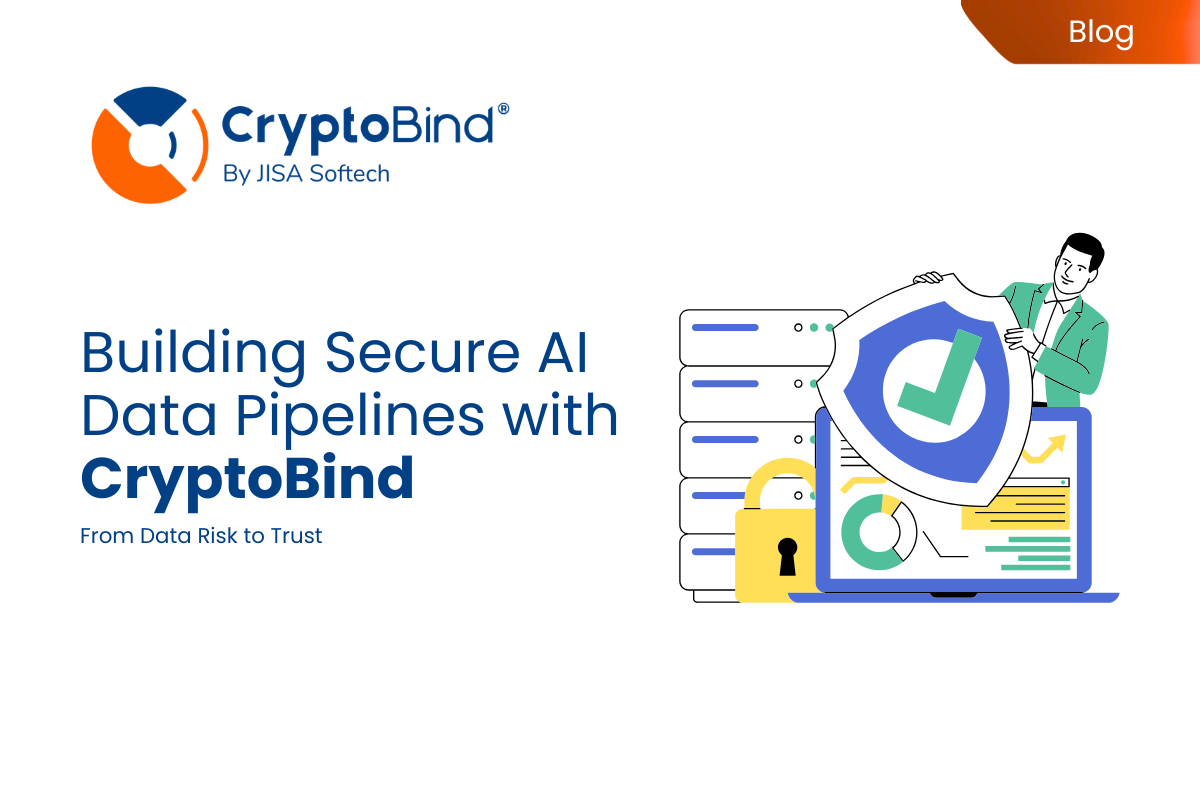
Building secure AI data pipelines with CryptoBind
Artificial Intelligence (AI) is as reliable as the data that it ingests. With enterprises broadening their use of AI in both essential industries such as the BFSI, healthcare, and government, the necessity to ensure the safety of data pipelines is a top-level issue on the boardroom’s agenda. The movement of sensitive data between ingestion, transformation, storage and inference layers poses a high risk unless it is controlled.
Current AI processes aren’t just data workflows. They’re valuable attack surfaces. To tackle this, organizations are moving towards architectures that integrate security into the data life cycle. This is where hardware-backed cryptography and tokenization play a pivotal role. Platforms like CryptoBind enable enterprises to build AI pipelines that are secure by design while maintaining performance and scalability.
Table of Content
The Expanding Risk Landscape in AI Pipelines
HSM + Tokenization: A Foundational Security Model
Reference Architecture: Secure AI Data Pipeline
CryptoBind’s Role in AI Data Security
Implementation Templates for Secure AI Pipelines
Business Impact and Strategic Benefits
The Expanding Risk Landscape in AI Pipelines
AI pipelines consist of a variety of systems that interact, each of which creates possible points of exposure. In contrast to conventional applications, AI processes tend to use large datasets, distributed processing and continuous data movement. This complication increases security issues.
Key risk factors include:
- Sensitive data are exposed in the ingestion and preprocessing.
- Temporary storage of raw data in logs, caches, and intermediate layers
- Absence of centralized management of key in distributed systems.
- Increased insider risk due to broader data access requirements
- Compliance gaps when handling regulated data (PII, PHI, financial data)
These risks raise a major concern, which is that AI systems need access to sensitive data, and access should be limited and restricted.
HSM + Tokenization: A Foundational Security Model
Strong AI security architecture incorporates two essential technologies, HSMs and tokenization. The combination of them forms a multifaceted defense framework that secures data as well as cryptographic keys.
Hardware Security Modules (HSMs)
HSMs offer an environment that is secure and non-tamperable to handle cryptographic operations. They make sure that encryption keys do not leave controlled hardware.
Core capabilities include:
- Secure key generation and storage within FIPS-certified environments
- Hardware-isolated encryption, decryption, and signing operations
- Centralized key lifecycle management with auditability
- High-performance cryptographic processing for large-scale AI workloads
Tokenization
In tokenization, the sensitive data are substituted with non-sensitive versions and ensure that usability is maintained without risk exposure. In contrast to encryption, tokenization also makes sure that original data is never directly processed unless there is a specific need to do so.
Key advantages:
- Format-preserving tokens maintain analytical and AI model utility
- Reduction of compliance scope by removing sensitive data from pipelines
- Elimination of data exposure in non-production environments
- Controlled and policy-driven detokenization
HSM and tokenization can be used together to create a zero-trust data architecture, in which sensitive data is never publicly disseminated unnecessarily.
Reference Architecture: Secure AI Data Pipeline
Designing a secure AI pipeline requires embedding controls at every stage. The following architecture outlines how HSM and tokenization integrate across the lifecycle.
1. Secure Data Ingestion
At the entry point, data must be protected immediately to prevent downstream exposure.
- Data is ingested through APIs or batch pipelines
- Sensitive fields are identified using classification rules
- Tokenization is applied in real time via CryptoBind APIs
- Encryption keys are dynamically managed through HSM
This ensures that raw sensitive data does not persist beyond ingestion.
2. Data Processing and Feature Engineering
During processing, maintaining data usability without compromising security is critical.
- Tokenized datasets are used for transformations
- Format-preserving tokens retain statistical consistency
- Controlled decryption (if required) is executed via HSM policies
- Intermediate datasets remain non-sensitive
This allows AI workflows to operate efficiently without exposing actual data.
3. Model Training
Training environments must ensure both data confidentiality and integrity.
- Training datasets remain tokenized throughout the process
- Dataset integrity is verified using cryptographic signatures
- Access to sensitive data is restricted through policy enforcement
- Model artifacts are signed and securely stored
This ensures that AI models are trained on secure, trustworthy datasets.
4. Model Deployment and Inference
Inference pipelines must protect both input and output data in real time.
- Input data is tokenized before being processed by the model
- Sensitive outputs are masked or tokenized
- Detokenization is strictly controlled and logged
- All access is governed by role-based policies
This enables secure real-time AI operations without data leakage.
CryptoBind’s Role in AI Data Security
CryptoBind provides an integrated platform that simplifies the implementation of secure AI pipelines by combining HSM, tokenization, and policy governance.
Key capabilities include:
- Cloud HSM Integration:
FIPS 140-3 Level 3 certified infrastructure for secure key management and cryptographic operations - Advanced Tokenization Engine:
Support for format-preserving, reversible, and irreversible tokenization models - API-First Architecture:
Seamless integration with AI pipelines, data lakes, and multi-cloud environments (AWS, Azure, GCP) - Policy and Access Control:
Fine-grained governance for detokenization and key usage with full audit trails - Compliance Alignment:
Built-in support for regulatory frameworks such as DPDP, GDPR, HIPAA, and PCI DSS
This unified approach allows organizations to implement security without disrupting AI workflows.
Implementation Templates for Secure AI Pipelines
To operationalize this architecture, organizations can adopt standardized templates that accelerate deployment.
Template 1: Tokenized Data Ingestion
- API gateway receives incoming data
- Sensitive fields identified via schema-based rules
- Tokenization applied using CryptoBind services
- Tokenized data stored in secure data lake
Use case: Financial transaction processing
Template 2: Secure Model Training
- Tokenized dataset used for training
- Data integrity verified via digital signatures
- HSM-backed key access ensures controlled cryptographic operations
- Model artifacts signed and securely stored
Use case: Healthcare analytics and diagnostics
Template 3: Controlled Inference Pipeline
- Input data tokenized before inference
- AI model processes non-sensitive data
- Detokenization allowed only for authorized outputs
- All activities logged for audit and compliance
Use case: Fraud detection and risk scoring
Business Impact and Strategic Benefits
Embedding HSM and tokenization into AI pipelines delivers measurable business value beyond security.
Key outcomes include:
- Reduced breach impact due to non-exploitable tokenized data
- Faster compliance with global and regional regulations
- Increased trust in AI outputs through data integrity assurance
- Scalability of AI initiatives across sensitive data domains
- Lower operational risk across distributed AI ecosystems
Security, in this context, becomes a business enabler rather than a constraint.
Conclusion
Data pipeline security should be a core focus as AI keeps transforming the way enterprises perform their operations. The HSM-backed cryptography and tokenization solution provide a flexible and future-proof system of securing sensitive information throughout the AI lifecycle.
Through CryptoBind, organizations can shift from the reactive approach to building systems with AI that is secure by default. This produces not compliant infrastructure only, but also trustworthy AI that can safely scale in high-risk data-intensive settings.
Ready to secure your AI data pipelines?
Connect with our experts to explore how CryptoBind can be tailored to your enterprise needs.