BYOK, HYOK, and BYOE explained: choosing the right key control model for your cloud strategy
In the fast-growing environment of cloud adoption, one question often comes into the Board’s mind, who are the ones who can actually take your data hostage and in our case access it? This will not only form your posture on encryption, it will also make up your whole risk profile of the cloud.
Three cloud key ownership models have emerged as the successful ones: Bring Your Own Key (BYOK), Bring Your Own Encryption (BYOE), and Hold Your Own Key (HYOK). Both are unique in terms of control, operation and regulation. It’s not just about knowing which model makes sense for a business, it’s essential.
This article delves into every model, discusses the actual applications, and identifies the way CryptoBind KMS affords seamless help across all three throughout major cloud environments.
Table of Content
The Trust Problem at the Heart of Cloud Encryption
Bring Your Own Key (BYOK): The Entry Point for Key Sovereignty
Hold Your Own Key (HYOK): Maximum Control for Maximum Sensitivity
Bring Your Own Encryption (BYOE): End-to-End Ownership of the Cryptographic Stack
Choosing the Right Model: A Strategic Framework
Why CryptoBind KMS Is Built for All Three
The Trust Problem at the Heart of Cloud Encryption
Cloud encryption has evolved a lot. AWS, Azure and Google Cloud all have strong default encryption security measures. The downside of default encryption is that the third party (the cloud provider) will also be in control of the keys and therefore be able, at least in theory, to access your encrypted data, share it with third parties, or access your data through a breach on their own.
This isn’t a suitable solution for companies storing proprietary financial information, medical data, want-to-know data, or for compliance with standards like GDPR, or HIPAA, FIPS 140-2, or the Data Protection Act (DPDP) Act in India. The following models of key control were developed to fill in this gap.
Bring Your Own Key (BYOK): The Entry Point for Key Sovereignty
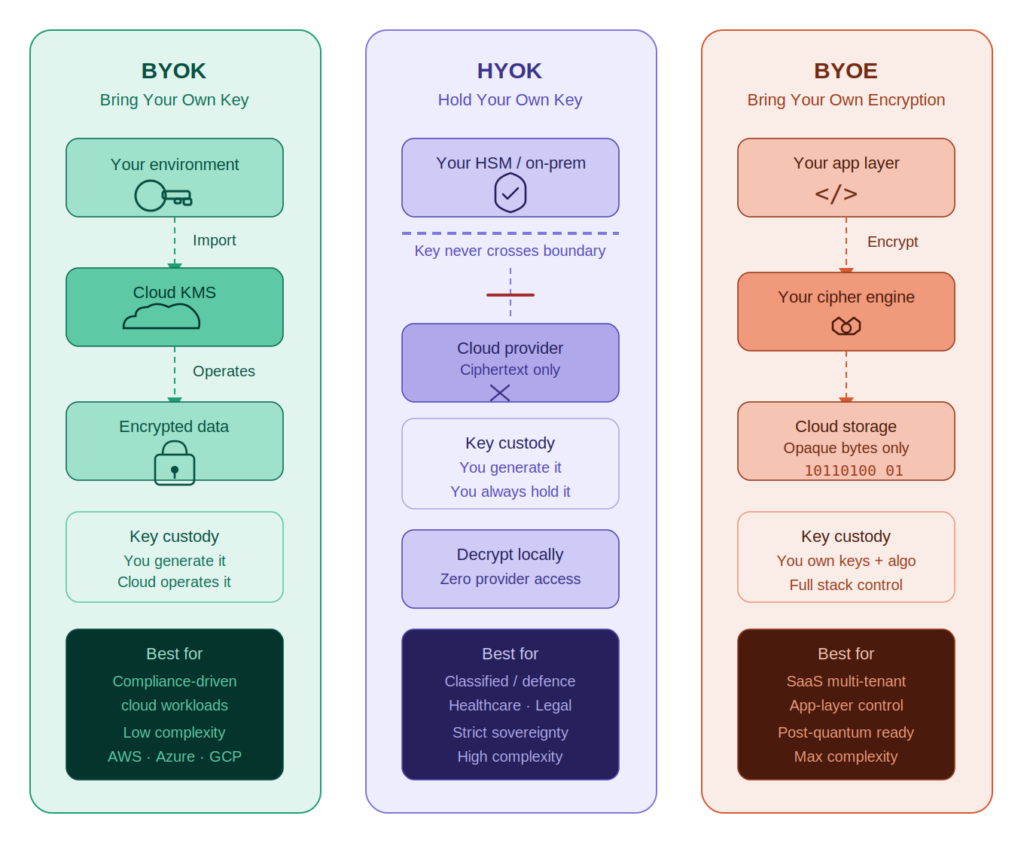
What it is: BYOK enables organizations to create their own encryption keys, and then provide them to the cloud provider’s Key Management Service (KMS). The cloud provider encrypts and decrypts with your key material for you.
What it delivers: What you really need is more control than keys generated by providers. There is the ability to rotate, revoke, and retireproof of-origin keys on an independent basis, and you hold proof of the key’s origin outside the provider’s infrastructure.
What it doesn’t deliver: A perfect separation. With BYOK you still have to import your key into, and use it in, the cloud providers’ environment. The keys of the provider are not stored in the provider’s KMS so the fact that they have been compromised does not guarantee that your key material is compromised.
Real-world use case: A multinational financial services (MFS) company with global operations wants to maintain key custody on AWS, while complying with regulators’ regulatory requirements. With BYOK, they can create keys on-premises in a certified Hardware Security Module (HSM), upload them to cloud KMS, and easily keep track of their key lineage, all while adhering to compliance regulations without compromising their cloud agility.
CryptoBind KMS support: CryptoBind KMS natively integrates with AWS KMS Custom Key Stores, Azure Key Vault, and Google Cloud EKM, allowing users to seamlessly implement BYOK workflows, while providing full key lifecycle management, automated rotation policies and audit trail generation from a single control plane.
Hold Your Own Key (HYOK): Maximum Control for Maximum Sensitivity
What it is: The most demanding of the three models is HYOK. With HYOK your infrastructure is the place where your keys stay. Encryption and decryption operations are executed on-site or in your environment and the cloud service provider never temporarily has access to the key material.
What it delivers: Actual key sovereignty. In the case of the cloud provider, it only sees the ciphertext, it does not see the key, and therefore does not have the ability to decipher your information even in the event of legal order, internal misuse and/or mistakes of the provider.
What it introduces: More accountability in the way you conduct yourself. Your organization shall have the availability, security and resilience of the key management infrastructure. If access to your encrypted data is lost because the HSM goes offline, the data could be lost.
Real-world use case: A government defense contractor storing classified Project information in a Hybrid cloud infrastructure faces a potential risk to exposing their most critical information to a third-party provider. An on-premises HYOK cluster deployed within their cloud environment, and connected to the cloud via HYOK, keeps sensitive workloads encrypted and keys never leave their organization. Likewise, Hospitals, or Health Care Agencies that maintain records derived from genomic information – or psychiatric information, keep the sensitive data absolutely under the command of their healthcare institution with the safe assistance of HYOK.
CryptoBind KMS support: CryptoBind KMS is designed to support HYOK deployments, using its HSM integrations based on on-premises and private cloud HSMs. Despite using cloud-based services for compute, storage and analytics, organisations can still have very strict key residency policies, set geo-fenced key access and retain 100% control of operation.
Bring Your Own Encryption (BYOE): End-to-End Ownership of the Cryptographic Stack
What it is: BYOE is the most full fledged model. Instead of using a cloud provider’s encryption engine, organizations choose to put in place their own encryption layer to manage keys, and the algorithms, libraries and processes that they use when encrypting data before it gets into the cloud.
What it delivers: Unwanted dependency on the provider’s cryptographic infrastructure. Organizations choose their own cipher suites, the use their own key derivation algorithm and they make sure that data is encrypted at the application layer before it is sent or stored.
Real-world use case: For a SaaS company with a multi-tenant platform used by multiple regulated customer organisations, it is important to know that the data for each particular customer must be encrypted with one key (set of keys) and that no one else, even a cloud provider for that SaaS company or the SaaS company itself, can decrypt the data belonging to that particular customer. BYOE allows to achieve this architecture by incorporating encryption at the application layer, with CryptoBind KMS handling the application layer key hierarchy per tenant.
CryptoBind KMS support: CryptoBind’s developer-first SDK and REST API allow organizations to seamlessly deploy application-layer encryption into their data pipelines, microservices, and SaaS applications. By providing support for AES-256, RSA, ECC, and post-quantum-ready algorithms, CryptoBind KMS offers the needed cryptographic flexibility in providing BYOE.
Choosing the Right Model: A Strategic Framework
There is no universally correct answer, only the right fit for your threat model, regulatory obligations, and operational maturity.
| Consideration | BYOK | HYOK | BYOE |
|---|---|---|---|
| Key leaves your environment? | Yes (temporarily) | Never | Never |
| Provider can access key? | Potentially | No | No |
| Operational complexity | Low–Medium | High | High |
| Best for | Compliance-driven cloud users | Highly sensitive/classified data | Multi-tenant SaaS, application-layer control |
| CryptoBind support | Full | Full | Full |
Organizations just beginning their key management journey often start with BYOK it dramatically improves their posture over provider-managed keys with manageable overhead. As data sensitivity increases or regulatory requirements intensify, the path toward HYOK or BYOE becomes strategically justified.
Why CryptoBind KMS Is Built for All Three
Most key management solutions focus on optimizing one given model. Designed specifically for BYOK, HYOK and BYOE, CryptoBind KMS offers a single management console for AWS, Azure, Google Cloud, and private cloud.
They include centralized key lifecycle management for hybrid and multicloud deployments, FIPS 140-2 level 3 HSM-backed key generation and storage, granular access policies and role-based and attribute-based access control, extensive audit logging to satisfy GDPR, HIPAA and ISO 27001 standards, and developer-friendly APIs that enable seamless BYOE integration.
The result is an enterprise key management platform that evolves to meet compliance needs at any stage and the most stringent sovereignty needs in regulated industries.
Conclusion: Key Control Is a Business Decision, Not Just a Technical One
The model you choose BYOK, HYOK, or BYOE signals more than a technical preference. It reflects your organization’s risk appetite, your customers’ expectations of trust, and your ability to demonstrate accountability to regulators and auditors.
As data breaches proliferate the news and laws and regulations are becoming firmer, the more forward-thinking organizations that stand at the pinnacle are those that regard encryption key control as a board-level concern, rather than a problem to be solved at the end of the week.
CryptoBind KMS gives you the architecture to act on that priority, whichever model fits your world.