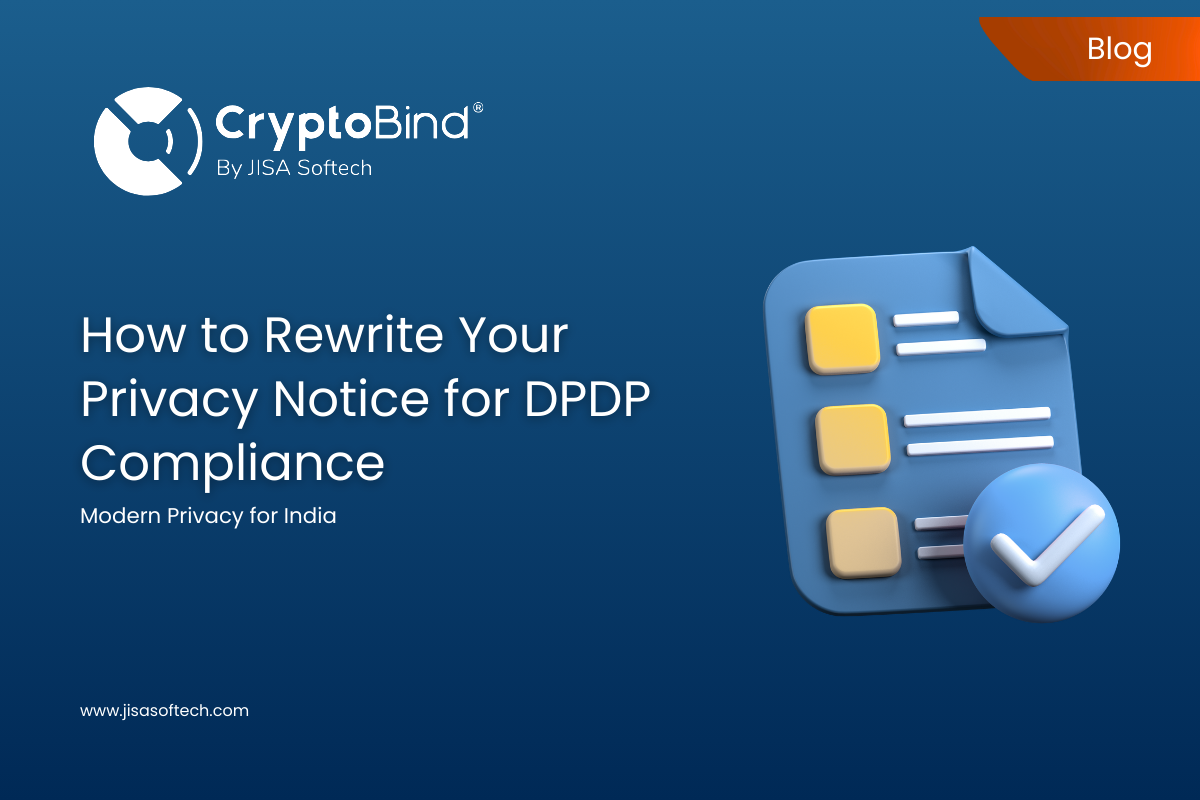
How to Rewrite Your Privacy Notice for DPDP Compliance
As the Digital Personal Data Protection Act moves into active enforcement, many organisations across India are reviewing one of the most visible parts of their compliance setup, the Privacy Notice. This document was often treated as a routine legal item, but it now serves a broader purpose. It shows how an organisation collects, processes, stores, and protects personal data, and it also demonstrates its level of responsibility toward the user.
Because of this shift, rewriting a Privacy Notice needs a careful mix of legal clarity, practical detail, user-friendly communication, and clear security assurance. This article explores how organisations can reshape their privacy notice for DPDP alignment, supported by practical structure guidelines, examples, templates, and a look at how platforms like CryptoBind strengthen the technical backbone of compliance.
A Shift in Mindset: From Legal Formality to Trust Artefact
DPDP brings a renewed method of data governance. Instead of long legal sentences, organisations are expected to use simple and direct language. The Privacy Notice has to act as a clear link between the data principal and the data fiduciary. It should explain what data is collected, why it is collected, how long it is kept, how it is shared, and which rights the user can exercise under the law.
This shift transforms the Privacy Notice into a trust artefact, a place where compliance, user experience, and security converge.
Building the Foundation: The Structure of a DPDP-Compliant Notice
A well-organised Privacy Notice helps users understand their rights and gives the organisation a strong compliance position.
Most notices begin with a short introduction explaining the organisation and the scope of the document. This prepares the user for what follows and clarifies the kinds of interactions covered by the notice.
Next comes a clear classification of the categories of personal data collected. DPDP places strong emphasis on specificity, meaning vague descriptors such as “we may collect your information” are no longer sufficient. Organisations should articulate data categories such as identity data, contact information, transactional records, device metadata, behavioural patterns, and any sensitive attributes if applicable.
Following this, organisations must outline the purpose of data processing, mapping each category to a legitimate business function. Whether the data is used for account creation, authentication, fraud prevention, service enhancement, or regulatory compliance, the intent must be stated unambiguously.
DPDP’s consent-centric model further requires clarity around when consent is needed, how it is obtained, and the mechanisms for its withdrawal. Similarly, the notice must present a transparent overview of data-sharing practices, not necessarily listing every vendor but clearly describing categories of service providers such as payment processors, analytics partners, cloud infrastructure providers, or regulatory authorities.
A retention section explains how long data is stored and why the duration is needed. This helps show accountability. After that, the notice should outline user rights such as access, correction, erasure, grievance resolution, and withdrawal of consent. The law expects timely responses, so the notice should clarify the general timelines.
The final part explains the security safeguards that protect personal data. The description should give confidence without detailing sensitive internal operations. It can mention controls like encryption and access restriction.
Examples and Templates: Bringing Clarity to Compliance
One of the simplest ways to strengthen transparency is through practical examples. For instance, instead of stating, “We collect your mobile number,” the notice could say, “Your mobile number is collected to verify your identity and secure access to your account.”
Similarly, a data-sharing disclosure can clarify:
“We share your personal data with regulated payment partners solely to process transactions you initiate. These partners operate under strict confidentiality and data protection agreements.”
Templates make the rewriting process more manageable, especially for organisations developing a notice from scratch. A good base template generally includes headings such as:
- Introduction
- Categories of Data Collected
- Purpose of Processing
- Consent Requirements
- Data Sharing
- Retention Policy
- User Rights
- Security Measures
- International Transfers (if applicable)
- Policy Updates
- Grievance Redressal
Each section can be adapted to the organisation’s operational realities while maintaining DPDP’s legislative expectations.
Where Technology Meets Compliance: The CryptoBind Advantage
A Privacy Notice is only as credible as the technology infrastructure supporting it. This is where CryptoBind, the deep-tech cryptographic stack from JISA Softech, becomes highly relevant.
While DPDP mandates “reasonable security safeguards,” modern enterprises require far more than baseline protection. CryptoBind’s suite, including Cloud HSMs, Key Management Systems, Tokenisation Engines, Privacy-Enhancing Technologies, and Quantum-Resilient Cryptography provides the cryptographic foundation necessary for organisations to operationalise the commitments expressed in their Privacy Notice.
For example, when a notice states that personal data is encrypted, CryptoBind’s FIPS-certified HSMs ensure secure key generation, storage, and rotation. When an organisation promises data minimisation or pseudonymisation, CryptoBind’s tokenisation capabilities reduce the exposure of raw personal identifiers. Audit logs within the platform support DPDP-aligned accountability, while time-stamping mechanisms reinforce data integrity.
Beyond compliance, CryptoBind helps organisations build technological resilience, aligning privacy governance with long-term security strategy, particularly essential as quantum-era threats emerge.
A Modern Privacy Notice as a Strategic Asset
Rewriting a Privacy Notice for DPDP does more than meet regulatory rules. It increases user confidence, strengthens the organisation’s public position, and supports responsible handling of personal data.
Clear structure, direct language, and practical examples form the base. The notice becomes even stronger when supported by reliable security technologies like CryptoBind. This combination helps organisations move from basic compliance to leadership in privacy management.
As India adopts modern digital governance practices, the organisations that treat the Privacy Notice as a strategic asset will be better prepared for a future where trust and responsibility guide data use.