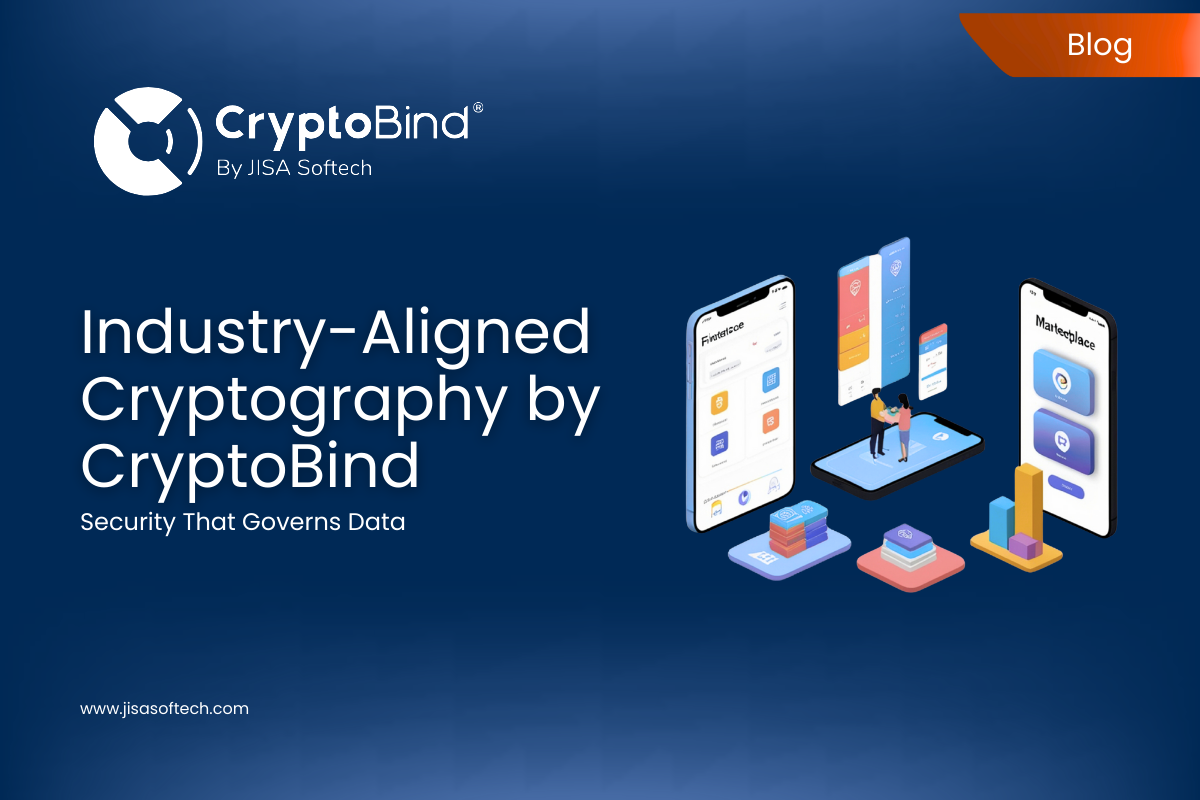
Industry-Aligned Cryptography by CryptoBind
Cryptography has become the invisible infrastructure of the digital economy. Every payment, every identity, every medical record, and every cloud workload ultimately depends on cryptographic trust. However, the majority of organizations continue to develop the cryptography as a generic security layer instead of a business critical control mechanism coherent with regulatory and business risk.
The reality is simple:
There is a difference in the threats to a bank, government agency, hospital, and a cloud-native enterprise, as well as the ability to secure them with the same cryptography architecture.
CryptoBind is built around this principle. It delivers industry-aligned cryptography, where encryption, key management, tokenization, and privacy controls are mapped directly to sector-specific compliance, data sensitivity, and real-world attack models.
Table of Content:
BFSI & Fintech: Cryptography as Financial Risk Control
Government: Cryptography as Digital Sovereignty
Healthcare: Cryptography for Patient Privacy and Clinical Integrity
Enterprises & Cloud: Cryptography for Zero-Trust Data
Why Industry-Aligned Cryptography Matters
BFSI & Fintech: Cryptography as Financial Risk Control
In banking and fintech, cryptography is not optional, it is the backbone of trust. Cryptographic keys are used to construct payment systems, digital wallets, trading platforms and KYC infrastructure that should never be revealed, cloned or abused.
CryptoBind allows BFSI organizations to leave software-based protection to hardware-based financial security.
CryptoBind enables BFSI organizations to move from software-based protection to hardware-rooted financial security.
Key use cases include:
- HSM-based key management to secure payment keys, PIN blocks, certificates, and signing keys
- Tokenization of PAN, Aadhaar, and account data to minimize breach and compliance exposure
- End-to-end encryption of transactions across APIs, switches, and settlement systems
These controls allow banks and fintech platforms to meet PCI DSS, RBI, SEBI, DPDP, and global financial regulations while still operating at real-time digital scale.
CryptoBind ensures that cryptography does not slow innovation, it makes it safe.
Government: Cryptography as Digital Sovereignty
With the digitization of government services, identity systems, taxation and records keeping of citizens, cryptography is under national control. The question is no longer just whether data is encrypted, but who owns the keys and trust anchors.
CryptoBind enables governments to build sovereign cryptographic infrastructure.
Core government use cases include:
- National PKI for digital identity, e-signatures, and secure portals
- Citizen data encryption using government-controlled master keys
- Cryptographic access control for inter-department data sharing
CryptoBind guarantees that national digital trust cannot be defeated by any foreign vendor, cloud provider or insider, since root certificate authorities and encryption keys are hosted within government owned HSMs.
This makes cryptography an instrument of control, rather than cybersecurity.
Healthcare: Cryptography for Patient Privacy and Clinical Integrity
Medical information is a singularly sensitive subject. Medical histories, diagnostic observations, and genetic information are highly confidential and legally confidential. Meanwhile, healthcare systems should exchange information among hospitals, laboratories, health insurance companies, and research networks.
CryptoBind enables healthcare organizations to protect privacy without blocking data-driven care.
Key healthcare cryptography use cases include:
- PHI encryption with healthcare-controlled keys
- Tokenization and pseudonymization for research, analytics, and claims processing
- Cryptographic audit trails for every data access and disclosure
This enables healthcare providers to comply with the HIPAA, DPDP, PDPL, and regional health privacy requirements and makes it possible to employ telemedicine, AI-based diagnostics, and interoperable care networks.
CryptoBind ensures that data moves where it should and nowhere else.
Enterprises & Cloud: Cryptography for Zero-Trust Data
Several clouds, SaaS services, API, and AI pipelines are used by modern enterprises. Conventional perimeter security can not defend data that flows in-between the systems.
CryptoBind delivers cryptographic zero-trust for data itself.
Enterprise and cloud use cases include:
- BYOK and HYOK to retain encryption key ownership even in public cloud
- Confidential computing to protect data while it is being processed
- Policy-based decryption where applications must prove identity and purpose
This makes it possible to allow enterprises to deploy cloud, analytics, and AI solutions without losing control over their most important resource data.
Why Industry-Aligned Cryptography Matters
Regulators no longer accept “encrypted” as a sufficient answer. They also would like to know who has access to the keys, who is able to decrypt the information, and whether the access can be restricted, proved, and audited whenever they want to. Cryptography has nowadays turned into a form of governance, rather than a security control, in modern compliance regimes.
CryptoBind was designed for this reality. By aligning cryptographic architecture with industry-specific risk, data sensitivity, and regulatory pressure, it transforms encryption from a technical safeguard into a platform for digital trust. Financial institutions are able to deal with systemic risk, governments are able to state data sovereignty, healthcare providers are able to maintain patient privacy, businesses can be able to migrate to the cloud and maintain control.
The organizations that master their cryptography will stamp their future in a world where data forms the basis of all business models and all service delivery to the people. The existence of CryptoBind is to make sure that control, compliance, and trust are designed in every digital transaction.