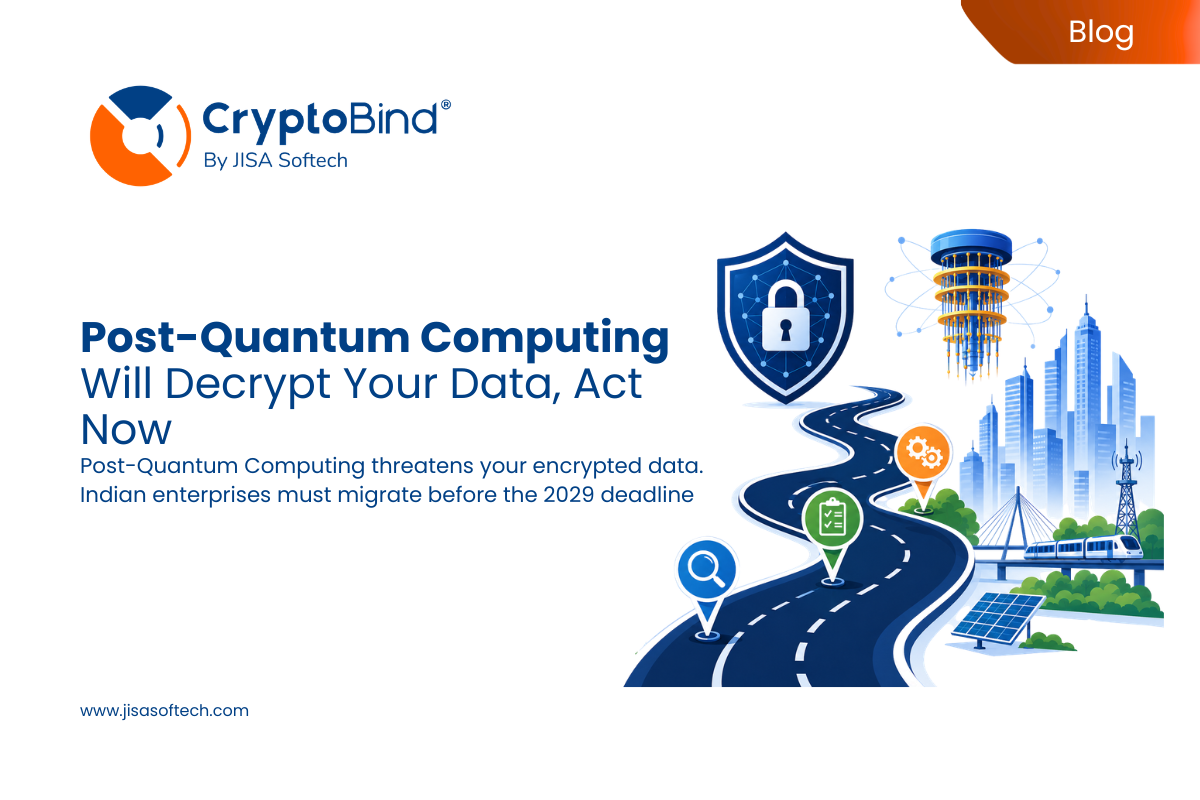
Post-Quantum Computing Will Decrypt Your Data, Act Now
Your encrypted data may already be in the wrong hands. Not decrypted yet but stored, waiting. And in a few years, when quantum computers reach their full potential, that data will be cracked open like it was never protected at all. This is not a future threat. For Indian enterprises, it is a present-day crisis that demands immediate action.
The Threat You Cannot See Yet
Cybercriminals and nation-state actors are already running what security experts call “Harvest Now, Decrypt Later” (HNDL) attacks. The strategy is simple: intercept and store encrypted enterprise data today, then decrypt it once post-quantum computing power becomes available. Your current encryption, RSA, ECC is mathematically unbreakable today. But quantum computers, powered by Shor’s algorithm, will render these protections obsolete.
The timeline is tightening fast. Google has officially set 2029 as its post-quantum cryptography (PQC) migration deadline. Cloudflare has followed suit. And critically, India has independently set a 2029 target for securing its critical information infrastructure. The convergence of these deadlines is not coincidence, it is a warning.
Why Indian Enterprises Are Particularly Exposed
India’s digital economy is growing at an unprecedented pace. Financial services, healthcare, manufacturing, and government infrastructure are all generating and transmitting sensitive data at scale. Much of this data, patient records, financial transactions, intellectual property, legal agreements, carries confidentiality requirements of 10 to 20 years or more. That is precisely the data adversaries are targeting today.
Consider the risk: a financial institution encrypting high-value wire transfers today assumes that encryption is permanent protection. Under the HNDL model, that assumption is dangerously wrong. Data stolen now and decrypted in 2029 exposes the institution to fraud, regulatory liability, competitive harm, and reputational damage, all at once.
Most Indian enterprises are not yet accounting for this risk. A 2026 industry estimate found that fewer than 20% of large enterprises globally have begun formal cryptographic inventories, the essential first step to quantum-readiness. In India, that number is lower still.
What Post-Quantum Computing Actually Means for Your Encryption
Post-quantum computing refers to the era when quantum computers became powerful enough to break the public-key cryptographic systems securing virtually all modern digital communication TLS, VPNs, email encryption, code signing, and database encryption.
NIST has already finalized three post-quantum cryptography standards: FIPS 203, FIPS 204, and FIPS 205, lattice-based algorithms (ML-KEM, ML-DSA, SLH-DSA) designed to withstand quantum attacks on existing infrastructure.
The challenge is that migrating to these standards is not a simple update. It requires inventorying every encryption touchpoint, remapping dependencies, selecting the right algorithms, and executing a phased migration. For large Indian enterprises, this can take 2 to 4 years. With a 2029 deadline, the window to start is now.
How CryptoBind Is Built for the Post-Quantum Era
CryptoBind is purpose-built to help Indian enterprises navigate exactly this transition. As a leading cryptographic key management and data protection platform, CryptoBind is designed with post-quantum readiness at its core, not as an afterthought.
Quantum-Safe Key Management: CryptoBind’s key management infrastructure is flexible enough to support enterprises in the migration; enterprises can move encryption keys and cryptographic policies without affecting current operations.
Crypto-Agile Architecture: CryptoBind is constructed on a crypto-agile groundwork which suggests that enterprises can change cryptographic plans from one to another with program plans, not redevelopment. CryptoBind enables you to match your encryption posture with PQC standards as they change over the years.
End-to-End Data Protection: End-to-End Data Protection covers anything from tokenization, encryption, to HSM integration, and BYOK (Bring Your Own Key). All of this is rolled into one layer of data protection that is built to be secure, regardless of the impact of quantum computers.
Compliance-Ready: India’s push towards enhanced data protection norms in the Data Protection Regulator Act (DPDPA) and meeting the 2029 deadline for QRZ critical infrastructure, CryptoBind enables enterprises to document and demonstrate their QRZ posture, giving an edge to security from a compliance lens.
CryptoBind ensures that when the quantum era arrives, your encryption does not become your biggest liability.
Four Steps Indian Enterprises Must Take Today
1. Build a Cryptographic Inventory Identify every system and data stream where public-key cryptography is in use, TLS certificates, VPNs, encrypted databases, API connections, and firmware. CryptoBind’s key management platform provides the visibility to start this inventory at enterprise scale.
2. Classify Long-Secrecy Data Prioritize data requiring confidentiality for 10 or more years, financial records, health data, legal contracts. This is your highest HNDL risk category and the first priority for migration.
3. Adopt Crypto-Agile Architecture If your infrastructure cannot change cipher suites without a full redeployment, it is already technical debt. CryptoBind’s crypto-agile design means algorithm transitions happen at the policy level, not the infrastructure level.
4. Begin Migration to NIST PQC Standards Transition high-risk systems to NIST-approved post-quantum algorithms. CryptoBind supports this migration with quantum-safe key management, ensuring your most sensitive data is protected first.
Waiting Is the Riskiest Strategy of All
There is a common misconception in Indian boardrooms: that quantum threats are still theoretical and action can wait. This logic is exactly what adversaries are counting on. By the time quantum computers can actively break encryption, it will be too late to protect data already harvested.
The organizations that emerge secure from the quantum era are those treating this as a migration project starting today. With India’s 2029 deadline, Google’s 2029 target, and NIST standards finalized, the framework for action exists. What remains is the decision to act.
The Bottom Line
Post-quantum computing is not a distant disruptor, it is an active threat to data your enterprise is generating right now. For Indian CISOs and security leaders, the question is no longer whether to act. It is whether you will start before the window closes.
CryptoBind is ready to help. From cryptographic key management to quantum-safe migration strategy, CryptoBind gives Indian enterprises the tools, architecture, and expertise to face the post-quantum era with confidence.
Build your inventory. Classify your data. Go crypto-agile. Migrate now with CryptoBind.