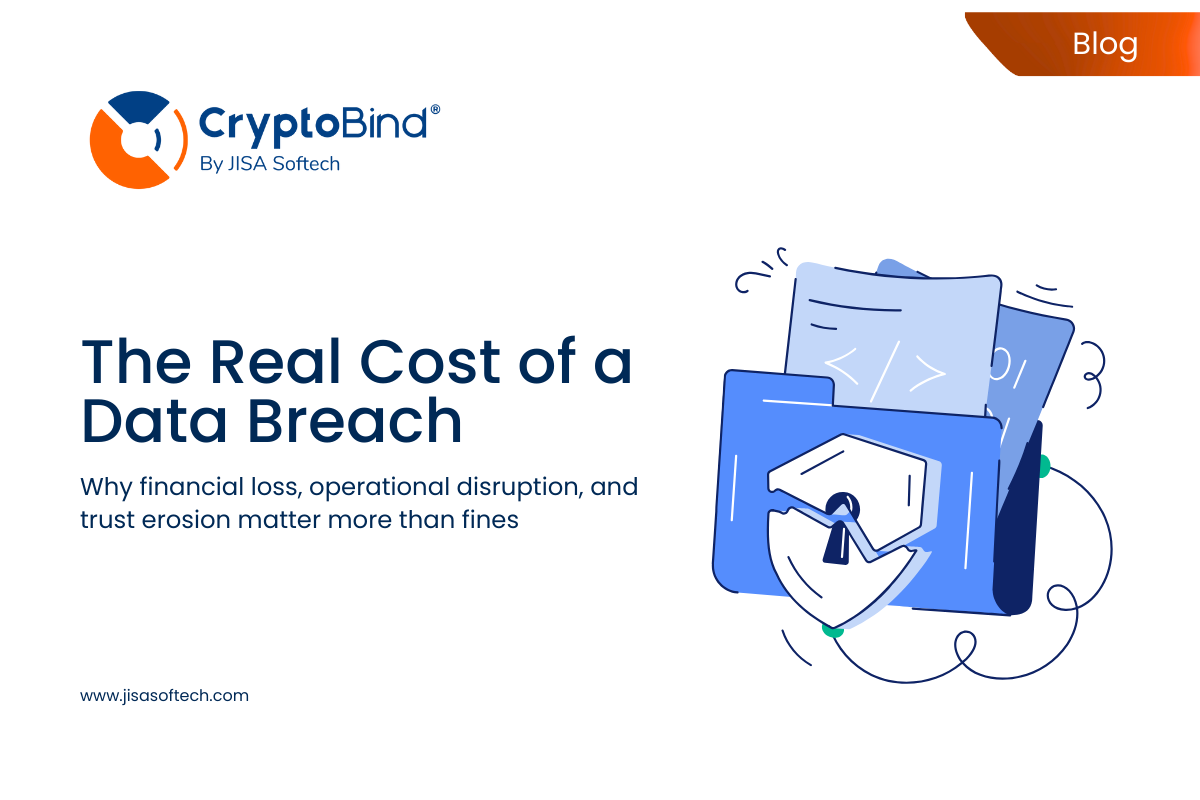
The Real Cost of a Data Breach: Why Data Protection Is Now a Boardroom Priority
Organizations will start and possibly end with regulatory fines when discussing the cost of data breach. Although the fines imposed on the framework of DPDP, GDPR, or industry regulations can be high, they are the tip of the iceberg. The real price of breach is much wider than reflected in monetary performance, operative stability, and durability.
Nowadays, data breaches are not isolated security incidents that occur in digital environments, characterized by cross-border data flows and rising regulatory accountability. They are the failure of data protection governance enterprise-wide.
Table of Content
Financial Losses Extend Well Beyond Compliance Penalties
Operational Disruption: When Data Becomes a Liability
Reputational Damage Is the Most Persistent Impact
The Shift From Cybersecurity to Data Protection
CryptoBind’s Role in DPDP-Focused Data Protection
Reducing Breach Impact Through Proactive Data Protection
Financial Losses Extend Well Beyond Compliance Penalties
Financial damage as a result of breach does not usually have a limit but regulatory fines do. Short-term expenses consist of forensic investigation, legal retaliation, notification to customers, and remediation strategies. They are normally preceded by the costly long-term impacts of higher insurance premiums and renegotiated contracts and the increased audit demands.
More importantly, violations interfere with income. Loss of customers, sluggish enterprise transactions, and stalled onboarding processes silently decrease financial performance. In the case of organisations that use DPDP and other laws of this nature, the non-compliance will also limit the data processing operations, which will have a direct impact on the continuity of the business.
The opportunity cost is what many people do not pay much attention to. Rather than focusing on growth, leadership is focused on crisis management. Innovation slows. Digital transformation initiatives fail, occasionally forever.
Operational Disruption: When Data Becomes a Liability
Operational fallout is amongst the least significant areas of a data breach. System isolation, access revocation, and emergency re-architecture is often needed in investigations. An attack can result in the partial or complete offline of core platforms, which affects customer and internal productivity.
IT and security teams are put into the reactive mode and the resources are not diverted. In organisations where data protection controls are fragmented it also becomes difficult by itself to figure out where sensitive data is located and how well it is secured.
APIs and cloud platforms are also being used by enterprises more and more, as third-party processors, cloud platforms, and cloud processors can expose the gaps in shared responsibility models. This causes down-stream disturbances among the vendors, partners, and supply chains, which intensifies operational risk.
Reputational Damage Is the Most Persistent Impact
There is no worse impact than reputation post-breach. Delays in service provision can be accepted by customers, but the loss of personal or sensitive information is the ultimate sabotage of trust.
Breach history in regulated markets is an irreversible element of vendor risk analysis, due diligence and enterprise procurement decisions. Couples require more significant guarantees. Customers are reluctant to publish information. Governance is questioned by the employees.
It takes time and money to gain credibility again and in some instances, it is not fully regained. This is the reason why progressive organisations consider data protection as a branding tool rather than a requirement.
The Shift From Cybersecurity to Data Protection
An important lesson of the recent breaches is that the conventional cybersecurity controls are not enough. Despite the presence of perimeter defenses, monitoring tools, and incident response plans, many different incidents do occur.
The underlying reason is frequently a poor quality of the data-centric controls: inconsistent encryption, bad key management, low data access visibility, and fixed cryptographic state that is unable to keep up with regulatory or other threat developments.
The contemporary laws including DPDP also focus on the accountability, limitation of purpose, and safeguarding of personal data in all its lifecycle. This demands the transition to the data-first protection approach rather than a system-oriented approach to security.
CryptoBind’s Role in DPDP-Focused Data Protection
At this point, solutions such as CryptoBind will be strategically beneficial, not as a reactive security solution, but as a entitlement to regulated, data protection-compliant data protection.
CryptoBind assists organisations to adopt centralized cryptographic governance that supports the DPDP principles by enhancing the security of sensitive data by means of regular encryption, access control, and managing the key life cycle. Decoupled cryptography allows a crypto-agile strategy – enterprises are able to modify encryption policies, turn keys, and react to regulatory changes, without impacting business operations.
DPDP-aligned organisations should also be long-term thinkers as cryptographic standards are continuously evolving and quantum threats are being developed. CryptoBind helps in maintaining an approach of data protection to be quantum-ready so that a transition can be effected to post-quantum cryptography later without compromising compliance and continuity.
This will keep the data that has been kept secure; not only today, but over regulatory change, technological change, and new threat environment.
Reducing Breach Impact Through Proactive Data Protection
The toughest organisations acknowledge the possibility of breaches and have systems in place to reduce the effects. In case sensitive information is regularly encrypted, keys are separated, and access is closely monitored, the worth of stolen information declines significantly.
This difference is important under DPDP and the like. Organisations that are able to show excellent data protection measures, cryptographic governance, and accountability will be in better position to minimise regulatory exposure, reputational harm, and recovery time even in cases of incidences.
Active data protection is no longer the prevention of penalties on their own. It is concerning the maintenance of trust and operational confidence in a digital-led economy.
Conclusion: Data Protection as a Strategic Imperative
The actual price of a data breach is not only in fines, but also in lost confidence, interrupted business and halted expansion. With increasing regulatory demands and growth of digital ecosystems, businesses should reconsider their data security measures of sensitive information.
The compliance of DPDP is not a checkbox; it is a long-term commitment to being a responsible data custodian. Cryptocurrency Investment in crypto-agile, Quantum-ready data protection foundations helps organizations to address current needs and be ready to deal with future threats.
It is those who take data protection as a strategic rather than a technical imperative, who will be in a stronger, more able, and more trusted position in the coming years.