Why India Needs Indigenous HSMs for DPDP Act and RBI Compliance
Nowadays, information is among the most precious resources of companies and states in the digital age. The cross-border and system-to-system flow of data necessitates the need by countries to ensure the confidentiality, integrity, and data availability of that data, particularly where it is citizens, financial transactions, or critical infrastructure. In the case of India, this need has been refined into an Indian national priority: data sovereignty. The core aspect of this priority is a underlying technology, Hardware Security Modules (HSMs).
With the ever-changing regulatory environment that has been introduced by the Digital Personal Data Protection Act (DPDP Act), the guidelines issued by the Reserve Bank of India (RBI), as well as international security frameworks such as the PCI DSS, native HSMs are no longer regarded as a nice-to-have but rather a must-have single component of a secure digital ecosystem.
Table of Content
Understanding HSMs in the Context of Regulatory Compliance
Why the DPDP Act Demands Sovereign Cryptography
RBI Compliance and the Need for Strong Key Management
PCI DSS Alignment for India’s Expanding Payments Ecosystem
Real-World Scenarios: BFSI and Government Use Cases
Strategic Infrastructure: Why Indigenous Matters
CryptoBind: Enabling India-First Cryptographic Trust
Understanding HSMs in the Context of Regulatory Compliance
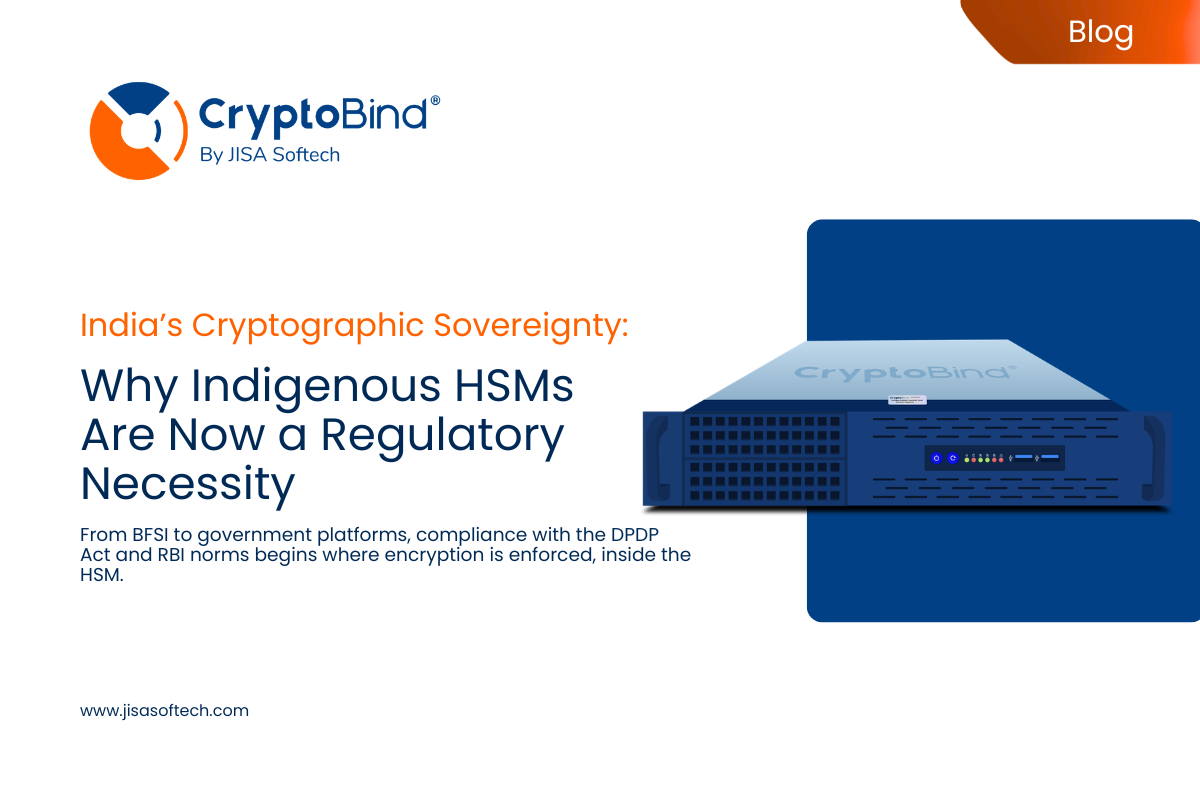
Hardware Security Modules (HSMs) are cryptographic crypto-controlled devices with high protection against tampering, which are used to generate, store and manipulate encryption keys in a secure fashion. They are the basis of the trust of encryption, digital signatures, authentication and certificate authorities.
In governments that have implemented the Digital Personal Data Protection Act (DPDP Act), encryption and effective key management are not the nice-to-have protective measures anymore; they are the essential parts of proving that the organization has reasonable security measures. HSMs provide:
- Distribution of secure cryptography keys.
- Tamper-proof key storage
- Forced key life cycle management.
- Audit-ready logging
In the absence of the hardware-based cryptography, the compliance will not be full and it will be vulnerable to operational risks.
Why the DPDP Act Demands Sovereign Cryptography
The Digital Personal Data Protection Act (DPDP Act) provides a law to handle digital personal data in India. It emphasizes:
- Legal processing of personal information.
- Data fiduciary responsibility.
- Safety measures to avert security breaches.
- Security of digital rights of citizens.
Although the Act is somewhat general regarding the provision of reasonable security controls, in the real world this is translated into the strong encryption of data and the key control mechanisms that can be verified. Where personal data is encrypted, but the cryptographic keys are under external jurisdiction, then there is the issue of sovereignty.
By means of this, indigenous HSMs will directly assist in compliance with DPDP Act by ensuring:
- Cryptographic keys are retained in India.
- The data protection controls are in line with the Indian audit requirements.
- Hardware-enforced measures of breach mitigation.
- Cryptographic processes can be easily seen by regulators.
Heavy monitoring of data is not enough to ensure the DPDP Act is really adhered to; the cryptographic keys of the data must also be controlled.
RBI Compliance and the Need for Strong Key Management
In India, the Reserve Bank of India has required strong cybersecurity controls of the banks, non-bank financial institutions, and payment service providers. These include:
- Coding of sensitive financial information.
- Secure digital signatures
- Effective authentication controls.
- Managed cryptography key life cycle.
In the case of banks being audited by RBI, the use of software based encryption might not offer enough confidence. The HSMs protect key extraction policies at the hardware level and authentic key extraction is practically impossible.
By implementing indigenous HSMs, financial institutions will benefit:
- Localized key custody was in line with expectations of RBI.
- Faster regulatory audits
- Less cross-border compliance issues.
- Better resistance against insider and external attacks.
PCI DSS Alignment for India’s Expanding Payments Ecosystem
The digital payment ecosystem in India is one of the quickest broadening in the globe. PCI DSS is a requirement to work with cardholder data.
PCI DSS requires:
- Card data that is stored is strongly encrypted.
- Safely stored cryptography keys.
- Policies of key rotation are documented.
- Restricted key access
The simplification of auditing of the PCI DSS with the help of the India-first HSMs also involves direct integration of the major lifecycle management into the tamper resistant hardware. This eases the compliance burden and enhances transaction trust in the case of payment gateways, ATMs networks and providers of POS.
Real-World Scenarios: BFSI and Government Use Cases
Scenario 1: A Large Indian Bank Preparing for RBI Audit
One of the major banks in the private sector had recurring audit findings with regard to the essential custody and intercountry cryptographic reliance. Although every piece of data was encrypted in one way, regulators wanted to better understand the location and management of keys.
Upon the implementation of an indigenous HSM platform:
- All keys had been created in the Indian jurisdiction.
- The destruction and key rotation policies were computerized.
- Audit logs became tamper-evident and regulator-ready
The outcome: less painful audits of the RBI and increased trust in their online banking channels.
Scenario 2: Government Digital Identity and Citizen Platforms
The tax filing, health records, and digital identity credentials government portals manage process large amount of personal data guaranteed by the Digital Personal Data Protection Act (DPDP Act).
Through incorporation of indigenous HSMs:
- The encryption of the citizen data is enforced through hardware.
- The ministries have regular key management policies.
- Rivalrous cryptographic bases of trust are sovereign.
This goes a long way in enhancing the national digital infrastructure and operational practices with the accountability framework of the DPDP Act.
Strategic Infrastructure: Why Indigenous Matters
There are the following risks associated with relying on foreign cryptographic hardware:
- Supply chain risks
- Poor regulatory disclosure.
- Geopolitical exposure
- Higher operational costs
The development of indigenous HSM is in support of:
- Atmanirbhar Bharat initiatives
- Local compliance-by-design architecture.
- More rapid response and customisation.
- Strategic cyberspace autonomy.
Cryptographic sovereignty is not the sole choice of a nation that is constructing one of the biggest electronic virtual infrastructures in the globe, but a prerequisite.
CryptoBind: Enabling India-First Cryptographic Trust
As an example of India becoming sovereign on cryptographic infrastructure, platforms such as CryptoBind can be cited. CryptoBind is a compliance-first built platform that supports:
- Encryption and key management that is in line with DPDP Act.
- Financial security controls that are in line with RBI.
- Payment cryptography ready to PCI DSS.
- Sovereign key Custody in India.
CryptoBind is a unified, hardware-based cryptography and back-end enterprise integration, which allows banks, financial technologies, and government structures to turn compliance into a strategic value.
The Way Forward
The Digital Personal Data Protection Act (DPDP Act) has radically changed the way Indian organizations should consider the issue of data security. Enforcement is no longer a paper-based one, it is a platform-based one.
Indigenous HSMs provide:
- Sovereign control
- Audit transparency
- Hardware-enforced encryption
- Regulatory alignment
- Augmented digital resiliency.
Since India has made a lead in achieving digital transformation, secure cryptographic infrastructure will dictate the legitimacy of such transformation. Indigenous HSMs, backed up by tools such as CryptoBind are not just security tools. They are national digital trust pillars.