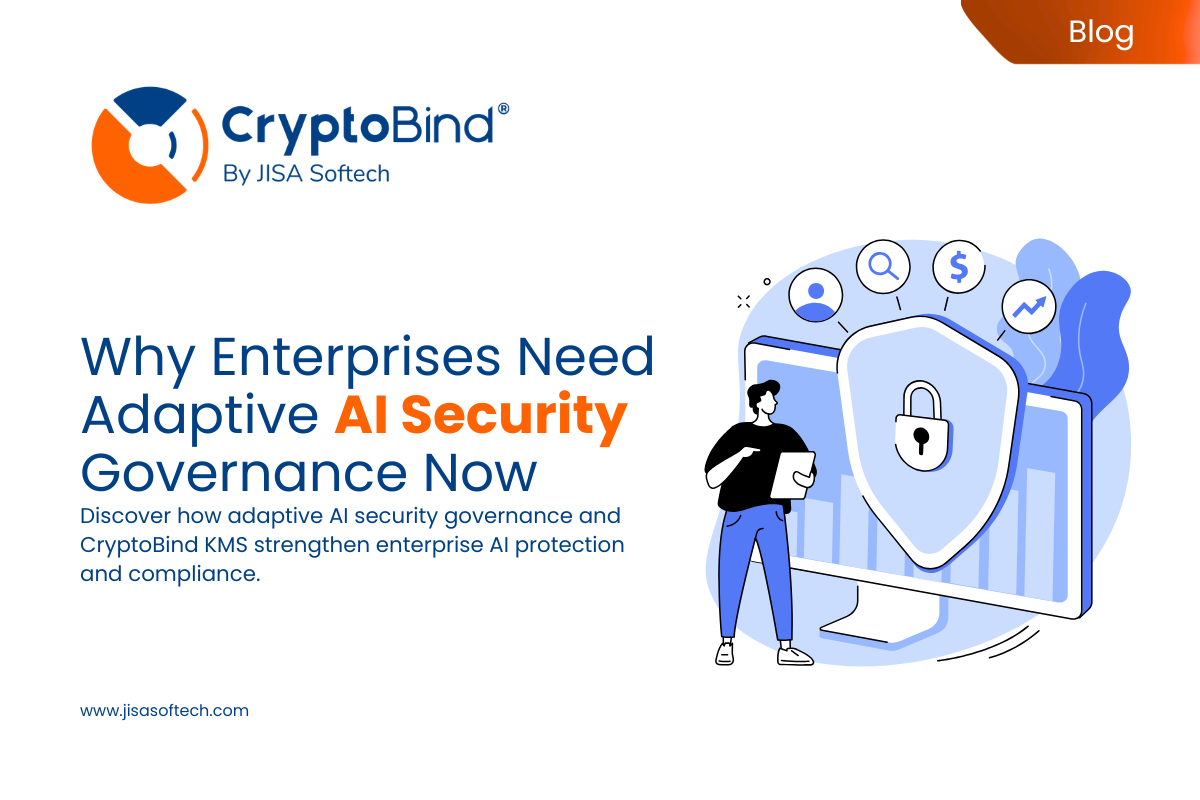
Why Enterprises Need Adaptive AI Security Governance Now
Artificial Intelligence is now moving beyond the fringe of enterprise innovation. It has been firmly integrated into business processes, customer engagement solutions, fraud detection, analytics, and business automation workflows. AI is increasingly becoming a vital tool for organizations in the BFSI, healthcare, government, telecom, and technology sectors to achieve greater efficiency and speed up digital transformation.
Despite the push of using AI, enterprise security models are not keeping up. For most of the time, the traditional cyber security standards that have been established are built around circumstances which are stable and predictable as far as applications and infrastructure structures go. AI systems are vastly differentiated. They change over time, they are reactive, handle vast amounts of data, and are integrated into distributed applications and learn from data-driven models and automated procedures.
The increasing level of complexity is compelling enterprises to challenge their current approach to how they govern, manage, and secure AI ecosystems. Static security policies are not sufficient anymore. With today’s technology, organizations need to implement a new paradigm: Adaptive AI Security Governance, which offers centralized encryption control, real-time policy enforcement, and intelligent handling of risks.
As enterprises shift from reactive security strategies to proactive AI governance models, solutions like CryptoBind KMS are taking on growing significance.
Table of Content
The Expanding AI Threat Landscape
Why Static Security Policies Are Failing
Understanding Adaptive AI Security Governance
The Role of Centralized Key Management
Real-Time Cryptographic Controls for AI Environments
Strengthening Compliance and Audit Readiness
Securing the Future of Enterprise AI
The Expanding AI Threat Landscape
When it comes to attack surface, enterprise AI systems are a lot more expansive than traditional applications. The components of AI environments include the interconnected datasets, APIs, machine learning pipelines, cloud infrastructure, model repositories and third-party integrations. With every layer comes a new potential means for cyber attacks and unauthorized access.
With AI’s greater role in the mainstream world of business, attackers are moving their attention towards compromising AI and the most sensitive aspects of the data assets. Some of the problems that are most urgent are:
- Data poisoning attacks targeting AI training datasets
- Theft of proprietary AI models and algorithms
- Unauthorized access to confidential enterprise data
- Prompt injection and manipulation attacks
- Insider threats involving privileged AI access
- Uncontrolled cryptographic key exposure across cloud environments
These risks are further compounded due to the cumulative nature of AI systems in the ever-evolving landscape. Conventional enterprise workloads cannot match model retraining, increasing dataset sizes, dynamically scaling infrastructure or integrating with external services.
However, in these contexts, it becomes hard to ensure a sound static governance mechanism.
Why Static Security Policies Are Failing
Current enterprise security models are based on a lot of pre-defination, regular auditing, and human owned encryption control handling. However, these methods are still applicable in legacy systems but have limitations in AI ecosystems.
For example, a current AI application could concurrently process customer information, interface with external APIs, take a look at actual behavior data, and produce automatic output. Static policies are unable to consider the evolving risk states among these interactions.
Decentralised encryption models can lead to blind zones in operations, too. In a multi-cloud environment, where encryption keys are dispersed throughout cloud service platforms, applications, databases, and services, there are multiple concerns organizations must deal with:
- Inconsistent policy enforcement
- Limited visibility into cryptographic operations
- Complex compliance reporting
- Delayed incident response
- Increased operational overhead
With the ongoing evolution of regulations like DPDP, GDPR, HIPAA, PCI DSS and newly emerging AI governance laws and regulations, enterprises must have an ongoing control on the access, encryption, processing and sharing of sensitive data.
This is shifting the paradigm to adaptive governance frameworks, able to respond to the risks on a real-time basis.
Understanding Adaptive AI Security Governance
AI Security Governance deals with the governance of AI security, specifically tailored to the dynamic and evolving nature of AI. Adaptive governance uses a constantly-opened and self-regulated risk evaluation to adhere to ever-changing security requirements through an automatic sequence of appropriate security controls.
At its core, adaptive governance focuses on three critical principles:
- Continuous visibility across AI infrastructure
- Centralized cryptographic governance
- Real-time policy enforcement
This model allows companies to not only obtain AI systems more intelligently but also remain flexible in their operations.
Adaptive AI security architectures, on the other hand, can react in real time to adapting to new environments like:
- User behavior anomalies
- Unauthorized access attempts
- Changes in data sensitivity
- Infrastructure scaling events
- Regulatory policy requirements
- Emerging threat intelligence indicators
In this ever-changing world, encryption becomes more than just a compliance checkbox. It is then the basis of trust, confidentiality, integrity, and resilience in AI systems.
Encryption alone fails to be enough though. Enterprises will truly become strong when they are able to manage and govern their keys with cryptography.
The Role of Centralized Key Management
In AI-driven multi-cloud and hybrid deployments, cryptographic key sprawl is an important hybrid governance issue. Encryption keys may be created and controlled by a variety of applications, databases, APIs, or cloud services, creating uncoordinated security operations.
CryptoBind KMS addresses this challenge by providing centralized key lifecycle management across distributed AI environments.
Through centralized governance, organizations can manage:
- Key generation
- Secure storage
- Rotation policies
- Revocation processes
- Access permissions
- Audit tracking
- Backup and recovery
This centralized approach significantly improves visibility while reducing the operational risks associated with fragmented encryption practices.
A key benefit is that enterprises can consistently apply security policy to every AI workload across the enterprise, regardless of their location.
Real-Time Cryptographic Controls for AI Environments
Modern AI systems require security controls that can respond instantly to evolving operational conditions. This is where real-time cryptographic governance becomes critical.
CryptoBind KMS enables organizations to dynamically enforce cryptographic policies based on contextual intelligence such as user identity, application behavior, geographic location, regulatory requirements, and risk indicators.
For example, if suspicious access activity is detected within an AI pipeline, organizations can automatically:
- Restrict access permissions
- Trigger stronger encryption requirements
- Rotate sensitive keys immediately
- Generate audit alerts for security teams
This proactive model helps enterprises reduce response times and minimize the impact of potential security incidents before they escalate.
Rather than reacting after a breach occurs, adaptive governance enables organizations to continuously strengthen their security posture in real time.
Strengthening Compliance and Audit Readiness
Regulatory expectations surrounding AI governance are increasing globally. Enterprises are now expected to provide detailed visibility into how sensitive data is protected, processed, and governed across AI systems.
For highly regulated industries such as banking, healthcare, insurance, and government, maintaining audit readiness has become a strategic priority.
CryptoBind KMS supports compliance initiatives by offering centralized reporting, tamper-resistant audit logs, policy-based governance, and secure cryptographic controls. This helps organizations simplify compliance management while improving operational transparency.
By integrating centralized key governance into AI infrastructure, enterprises can better align with:
- DPDP compliance requirements
- GDPR data protection mandates
- RBI cybersecurity guidelines
- PCI DSS encryption standards
- HIPAA security controls
This reduces compliance complexity while improving enterprise-wide governance maturity.
Securing the Future of Enterprise AI
AI is rapidly reshaping how enterprises operate, compete, and innovate. However, as organizations increase their dependence on intelligent systems, security governance must evolve accordingly.
The future of AI security will not be driven solely by perimeter defenses or isolated security tools. It will depend on adaptive governance frameworks capable of securing continuously evolving ecosystems through centralized cryptographic intelligence and proactive policy enforcement.
Organizations that continue relying on static governance models may struggle with:
- Expanding security blind spots
- Increasing compliance risks
- Delayed incident response
- Lack of visibility across AI operations
- Fragmented cryptographic management
In contrast, enterprises adopting adaptive AI governance frameworks will be better positioned to secure sensitive data, protect AI intellectual property, maintain compliance readiness, and build long-term trust in intelligent systems.
Conclusion
Enterprise AI is moving and it’s opening up real opportunities across automation, innovation, and operational efficiency. But it’s also surfacing governance and security challenges that most existing frameworks simply weren’t built for.
The core problem is a mismatch. Traditional security policies were designed for stable environments. AI systems are anything but data moves constantly, infrastructure scales on demand, and the threat landscape shifts faster than static rules can keep up with. What worked before isn’t enough anymore.
What enterprises need now is security that adapts. Centralized cryptographic control, policies that respond intelligently to changing conditions, and risk management that works in real time, not after the fact.
This is the gap that solutions like CryptoBind KMS are designed to fill. Centralizing key management and enforcing cryptographic policies proactively gives organizations a practical foundation for governing AI environments at scale.
The organizations getting ahead of this now will be in a much stronger position down the line. As AI becomes more deeply embedded in core operations, the ability to manage risk, stay compliant, and maintain trust won’t be optional, it’ll be the baseline. Building that foundation today is what makes it possible.