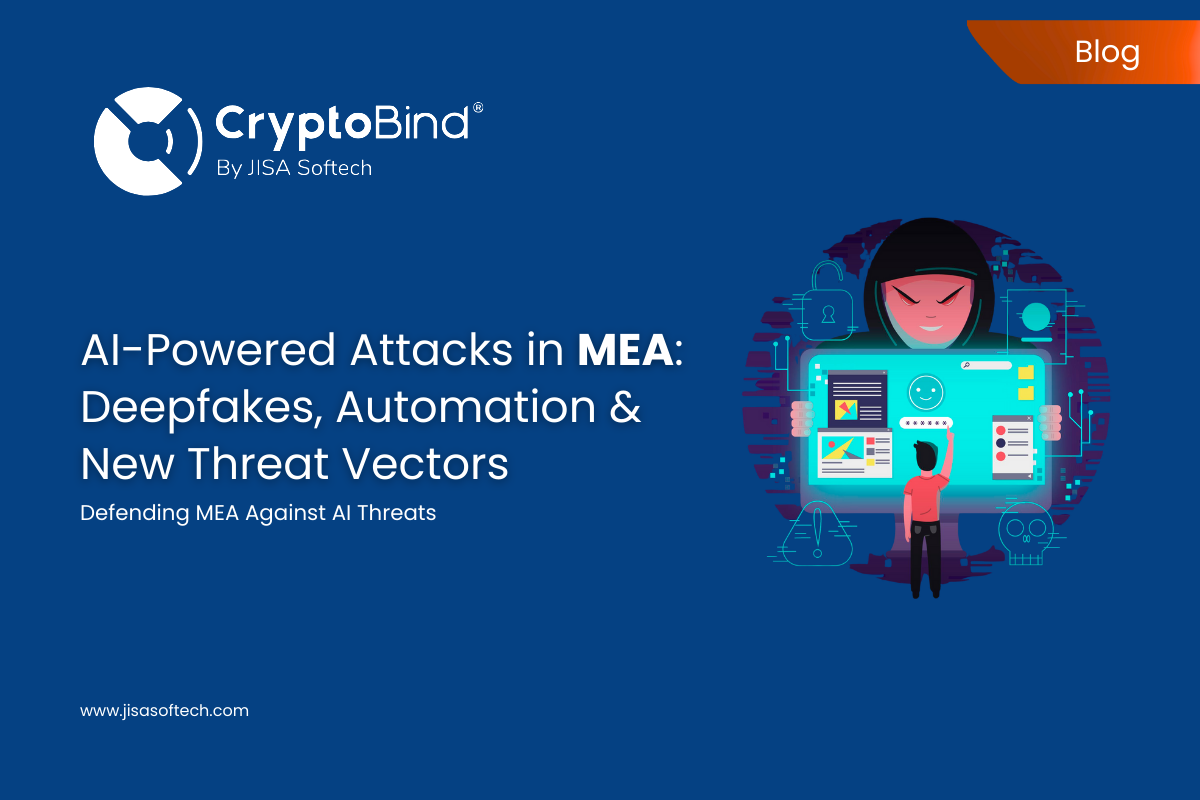
AI-Powered Attacks in MEA: Deepfakes, Automation & New Threat Vectors
The Middle East and Africa region is moving through a fast digital shift. This shift covers national identity programs, city-wide digital services, modern financial platforms, and enterprise strategies that center on AI. Growth in these areas is steady, yet it also brings new cyber risks that change at a fast pace. AI-powered attacks are no longer seen as ideas on paper. They are used in real incidents, and they change how risk is understood in the region.
During the past year and a half, regulators in the UAE, Saudi Arabia, Qatar, Bahrain, and South Africa noted that AI-enabled threats are now strategic risks. They require strong oversight. These threats include deepfakes, autonomous malware, credential theft, and AI-guided social engineering. They affect how boards plan budgets and how compliance teams shape controls.
This article reviews three forms of AI-powered attacks that are causing the most disruption. These forms are deepfakes, automated cyber tools, and new risks that appear when organizations deploy GenAI systems. It also explains how platforms like CryptoBind help build cryptographic strength, privacy controls, and reliable identity assurance. These features are needed to counter the next group of AI threats.
Table Of Content
Deepfakes: The New Social Engineering Superweapon
Automation-Driven Cyber Offensives: From Malware to Autonomous Exploitation
New Threat Vectors Born from GenAI Adoption
CryptoBind: Strengthening MEA’s Defense Against AI-Powered Threats
Conclusion: The Future Security Battle Will Be Machine-Versus-Machine
1. Deepfakes: The New Social Engineering Superweapon
Deepfakes have moved from novelty to weaponization. MEA enterprises, particularly in banking, oil & gas, aviation, government, and logistics, are already reporting attacks that combine:
- Voice cloning for CEO fraud
- Synthetic video to authorize transactions
- Impersonation of government officials
- Manipulated evidence in disputes or investigations
The danger is not just realism, it is scalability. With open-source AI models, an attacker requires only seconds of audio to create a convincing clone. Traditional verification mechanisms OTP, voice authentication, email approvals are increasingly insufficient.
Across the GCC, the financial and public sectors are most exposed. SAMA-regulated banks, for example, now face both reputational and systemic risk if deepfake-enabled fraud breaches high-value workflows like treasury operations or cross-border payments.
Countermeasure Direction for 2025–2027:
- Cryptographically authenticated video/voice workflows
- Hardware-backed signing to validate intent
- Zero-trust identity for all high-risk transactions
- AI-detection pipelines for media manipulation
Trusted digital identity and verifiable signatures will become foundational to preventing high-impact impersonation attacks.
2. Automation-Driven Cyber Offensives: From Malware to Autonomous Exploitation
If deepfakes target humans, AI-driven automation targets infrastructure. Adversaries now use AI to:
- Auto-generate malware variants to evade EDR
- Identify misconfigurations and exploitable APIs
- Auto-probe cloud environments for privilege escalation
- Weaponize LLMs for phishing-at-scale
- Build self-updating attack chains that learn from failed attempts
MEA’s cloud adoption boom especially in UAE, Saudi Arabia, and Qatar, is expanding both the attack surface and the opportunity for automated exploitation. Fast-moving industries like fintech, telecom, and transport that depend on API ecosystems are particularly vulnerable.
The offensive advantage stems from machine-speed reconnaissance. Attackers no longer need weeks; they need minutes. Defenders relying on manual correlation or siloed monitoring cannot compete.
Countermeasure Direction for 2025–2027:
- Continuous cloud posture management
- Automated remediation for high-risk misconfigurations
- HSM-backed API signing to prevent rogue calls
- Policy-driven encryption and tokenization for high-value data
The region will see growing emphasis on cryptographic enforcement, machine-speed detection, and autonomous defensive tooling that matches offensive velocity.
3. New Threat Vectors Born from GenAI Adoption
As MEA enterprises deploy GenAI for customer service, workflow automation, analytics, and national programs, new vulnerabilities are emerging:
- Model Manipulation (Prompt Injection & Data Poisoning)
Attackers can steer or corrupt AI systems embedded in banking, travel, or citizen services. - Unauthorized Data Exposure
Training data leaks can expose PII, PHI, financial information, or state-sensitive datasets. - Shadow AI Risks
Employees unknowingly upload sensitive documents into public AI tools, violating PDPL, DIFC DP, or DPDP regulations. - Synthetic Data Overconfidence
Organizations may rely on AI-generated “clean data,” overlooking representational bias or hidden leakages.
Regulators are responding:
- Saudi PDPL maturity assessments now evaluate AI data governance.
- Qatar’s NCSA emphasizes secure AI pipelines.
- UAE’s NCA highlights model integrity and authenticated access to critical AI assets.
But governance alone isn’t enough. Organizations need cryptographic guardrails, secure key orchestration, and privacy-enhancing technologies (PETs) to ensure AI systems do not introduce systemic vulnerabilities.
CryptoBind: Strengthening MEA’s Defense Against AI-Powered Threats
As AI-driven attacks intensify, the foundation of resilience lies in trusted cryptography, secure key management, and privacy-first controls. This is where CryptoBind, under JISA Softech, becomes a strategic enabler across MEA enterprises, government agencies, and regulated industries.
CryptoBind provides a quantum-ready security stack built around:
1. CryptoBind Cloud HSM & Payment HSM
Ensures signing keys, transaction keys, and identity credentials remain hardware-protected, even against AI-automated credential theft or deepfake-driven fraud attempts.
2. CryptoBind KMS & Key Lifecycle Governance
Centralizes key generation, rotation, policy enforcement, and audit logging across cloud, on-prem, and hybrid environments. This helps organizations achieve SAMA, NCA, QCB, UAE PDPL, and PCI compliance while closing AI-exploitable gaps in authorization flows.
3. Tokenization & PET Framework
Enables data minimization and irreversible pseudonymization, reducing the blast radius of AI-powered data harvesting or prompt-injection attacks that leak sensitive datasets.
4. AI-Ready Cryptographic Assurance
Hardware-backed signing, timestamping, and certificate validation anchor human and machine identity, critical to defending against deepfake authorization attempts and automated impersonation workflows.
5. Quantum-Resilient Roadmap
CryptoBind’s architecture anticipates the shift to post-quantum cryptography (PQC), ensuring MEA organizations can future-proof against next-generation cryptanalytic attacks.
By embedding CryptoBind into digital trust architectures, MEA enterprises can transition from reactive defense to cryptographically assured, privacy-preserving, AI-aligned security.
Conclusion: The Future Security Battle Will Be Machine-Versus-Machine
AI-powered attacks represent a major shift in the regional cyber environment. Deepfakes reduce trust. Automation increases the pressure on defense teams. GenAI introduces new types of exposure.
The region is responding with stronger regulations, cybersecurity investments, and national AI strategies but technology must match intent. The next phase of cybersecurity will rely on:
- hardware-backed trust
- cryptographically verifiable identity
- zero-knowledge workflows
- privacy-by-design engineering
- quantum-resilient cryptography
- automation that defends at machine speed
CryptoBind’s group of tools HSMs, KMS, tokenization, PETs, and quantum-resistant methods, forms a base of trust that supports secure growth in an AI-focused world.Those who act early will not only mitigate risk but build competitive advantage through secure innovation.