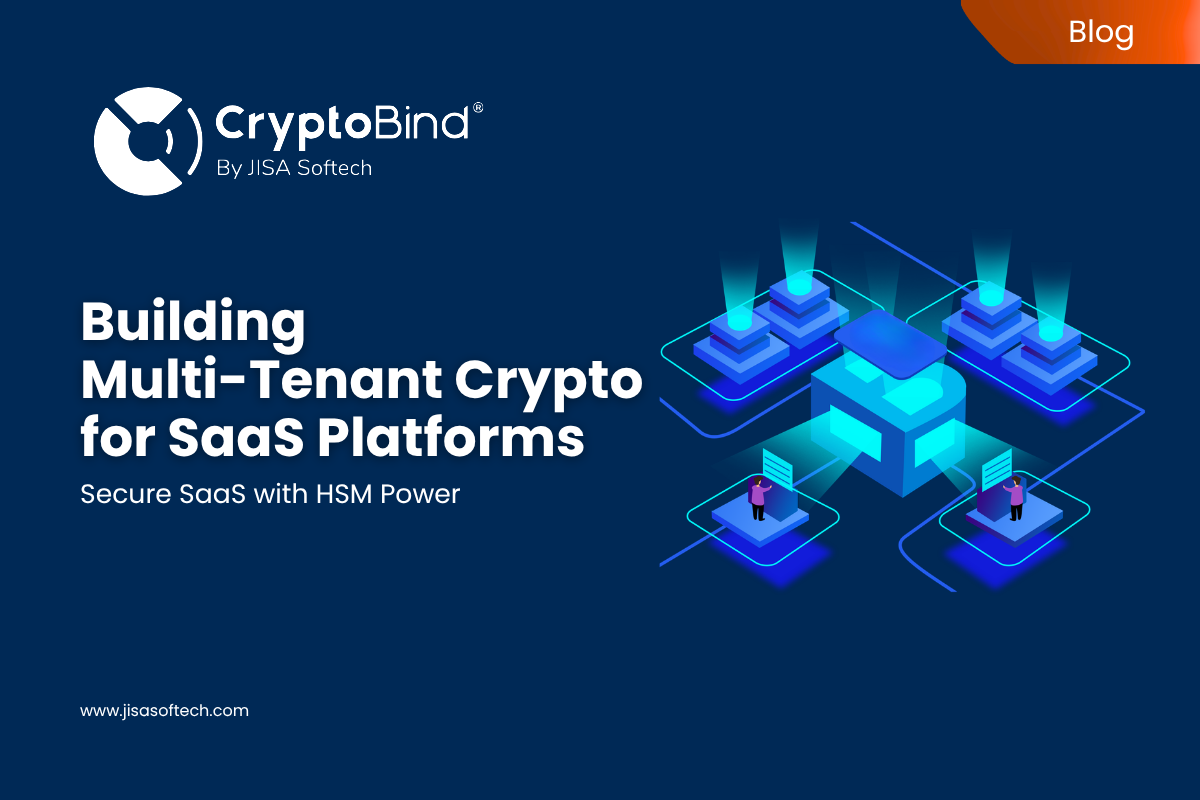
Building Multi-Tenant Crypto for SaaS Platforms
Cryptographic architecture has emerged as a characteristic of platform trust as SaaS platforms keep scaling across these domains, geographies and regulatory environments. Encryption and key management are no longer located in the back-end security layers; the fundamental components of the manner SaaS platforms provide tenant isolation, data confidentiality, and compliance.
Multi-tenancy introduces inherent complexity. Although efficiency is fostered by infrastructure sharing, logical isolation is required to be very high, particularly in cases where sensitive information like financial records, health records and personally identifiable information (PII) is involved. Here, it is not a choice to develop a strong multi-tenant crypto architecture; rather it is a prerequisite.
Table of Content
The Architecture Imperative: Why Crypto Must Be Tenant-Aware
Tenant-Isolated Keys: Establishing Cryptographic Boundaries
HSM Partitions and Virtual HSMs: Enabling Secure Multi-Tenancy at Scale
API-Level Encryption Strategies: Securing Data in Motion
Integrating Cryptography into SaaS Workflows
CryptoBind: Enabling Scalable Multi-Tenant Cryptography
The Architecture Imperative: Why Crypto Must Be Tenant-Aware
In conventional systems, cryptography was commonly done on a system-wide basis. Nevertheless, SaaS platforms need to be handled in a more disaggregated way. All tenants are independent trust boundaries, and cryptographic controls need to consider that fact.
In the absence of tenant-conscious cryptography, the risks are doubled, with unauthorized access being the most common and compliance breaches being the least. A well-designed system would mean that in case any single tenant is compromised, the effect would not spread across the platform. This is the point when the tenant-isolated keys, HSM-based security, and the API-level encryption strategies are merged together to developed a safe architecture.
Tenant-Isolated Keys: Establishing Cryptographic Boundaries
Isolation of tenants starts at the key level. Every tenant should have a cryptographic identity belonging to it, with independent keys and policies. This provides scopes, auditable and non-overlapping encryption operations.
One practical solution is to have a hierarchical key hierarchy with a tenant-specific root key which controls all derived keys that are used in encryption, signing and tokenization. This model does not just impose isolation, but also makes lifecycle management easy.
To operationalize this effectively, SaaS platforms typically rely on:
- Envelope encryption, where data encryption keys are protected by master keys stored in secure environments
- Automated key rotation policies to reduce long-term exposure risks
- Granular access controls, ensuring only authorized services can invoke cryptographic operations
This structure enables platforms to maintain both security integrity and operational efficiency, even as tenant volumes scale.
HSM Partitions and Virtual HSMs: Enabling Secure Multi-Tenancy at Scale
Hardware Security Modules (HSMs) provide a tamper-resistant environment for storing keys and performing cryptographic operations. But the difficulty with SaaS systems is how to make HSM facilities multi-tenant, without affecting isolation or scalability.
This is solved in HSM partitioning where one physical HSM can be partitioned into several logically isolated segments. Each partition functions as an independent cryptographic domain with its own keys, policies, and access controls. This is a tradeoff between cost-effectiveness and high isolation, which is why it is appropriate in the case of enterprise SaaS deployments.
Virtual HSMs extend this concept into the cloud. SaaS platforms are capable of dynamically providing dedicated HSM instances instead of using physical hardware only. These virtual environments provide a copy of security of traditional HSMs and provide the flexibility demanded by modern architectures.
Key advantages of this model include:
- The ability to onboard new tenants rapidly without provisioning physical hardware
- Elastic scaling of cryptographic workloads based on demand
- Built-in support for high availability and disaster recovery
By combining HSM partitions and virtual HSMs, SaaS platforms can create a cryptographic backbone that is both secure and adaptable.
API-Level Encryption Strategies: Securing Data in Motion
Although HSMs secure keys, the bigger problem is to ensure data is safeguarded as it flows through the system. In distributed SaaS architectures, often built on microservices and APIs, data is constantly in transit. This makes API-level encryption strategies critical.
Instead of just using transport-level security, the current day platforms incorporate encryption as part of application processes. This makes sure that data is not leaked regardless of its path in the system.
Common strategies include:
- End-to-end encryption where the data is encrypted at the source and is only decrypted at the targeted location.
- Field-level encryption, that aims at sensitive data elements in larger datasets.
- Tokenization, replacing sensitive values with non-sensitive equivalents to reduce exposure
Also, secure API design will include cryptographic authentication, like mutual TLS and digitally signed payload. These controls prevent data integrity as well as ensuring the integrity and authenticity of each transaction.
The result is a system where data protection is continuous, not event-based.
Integrating Cryptography into SaaS Workflows
One of the most frequent errors in SaaS architecture is to consider cryptography a single-purpose system. As a matter of fact, it should be thoroughly embedded into the fabric of the work of the platform.
It implies the integration of cryptographic services and identity and access management systems, key management integration into DevSecOps pipelines, and audit logs that pose full transparency of cryptographic activities. Encryption can also be used as an enabler but not a bottleneck when it is done correctly.
Equally important is performance optimization. Cryptographic functions have an effect of introducing latency when not implemented efficiently. USC: The necessary operation to ensure user experience is at scale is to leverage hardware acceleration with the HSMs, cache non-sensitive operations, and API calls optimization.
CryptoBind: Enabling Scalable Multi-Tenant Cryptography
Solutions such as CryptoBind are particularly important in this dynamic environment, as they simplify the challenge of cryptographic infrastructure and still offer the same levels of security as enterprises.
CryptoBind is a dedicated SaaS environment with built-in features including dedicated virtual HSM instances, key isolation in tenants and cryptographic services provided at the API level. Its design allows the organizations to make use of secure multi-tenant crypto without the cost of managing physical HSM infrastructure.
CryptoBind supports the adoption of such standards as PKCS11 and offers REST-based integrations, which means that it can be easily integrated into an existing SaaS infrastructure. It also complies with the world requirements of compliance and thus is suitable to regulated industries.
In the case of SaaS providers, it can be translated into a more rational benefit: the capacity to provide secure, compliant, and scalable cryptographic services and concentrate on the main product development.
Conclusion: From Encryption to Cryptographic Governance
The idea of having a multi-tenant crypto on a SaaS platform is not solely about encryption, but also the creation of cryptographic governance on a large scale. With the heightening regulatory pressures and an augmentation in data sensitivity, there is a greater necessity to have strong, tenant-sensitive security models.
With a mixture of tenant isolated keys, HSM partitions or virtual HSMs and sophisticated API-level encryption schemes, SaaS platforms can establish a safe backbone to enable both expansion and conformity.
In the end, it is intended that all tenants should exist within a safe, walled off cryptographic environment, which does not affect performance or scalability. That way, SaaS platforms do more than secure data: they generate the trust that is the hallmark of long-term success in a digital-first world.